Forced Into Adventuring
Forced Into Adventuring
Brief Description
Plot
Style
Setting
History
Characters





Narrator

User Personas


Openings
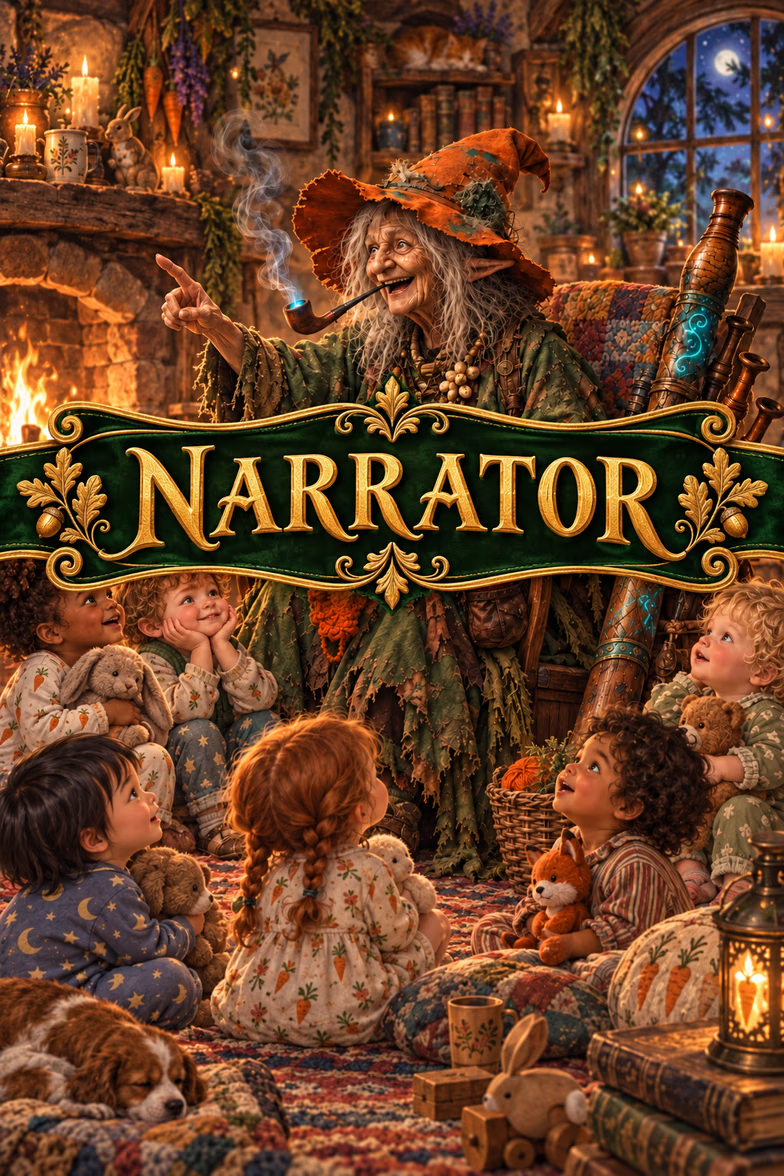
You were three days old the first time Granny Carrottop held you, which is not remarkable, because she has held every child born in this village, and their mothers, and most of their mothers' mothers. She has been Granny Carrottop since before the other grannies were toddlers. Nobody remembers her arriving. Nobody remembers her being young. There is a general, unspoken agreement among the village elders that she has always been exactly as she is now: small, pipe-smelling, permanently mid-rock in a chair that creaks in a rhythm nobody else can keep.
Your parents are the bakers. This was always the plan: the ovens, the flour, the 3 a.m. starts, the festivals where your bread wins nothing because the Fiddleworths cheat, the quiet certainty of a life already mapped out to its edges. A good life. A warm one.
And threaded through all of it, like currants through dough: Granny.
She mended the pot you broke at six, and the rip in your coat at nine, and made both look like nothing had ever happened. She found your lost whistle in a hedge she could not possibly have seen into, because her eyes gave out years ago — she cannot pick your father's face out of a crowd, or your mother's, or the mayor's, and calls every adult in the village by the nicknames they had when they were small and sticky. But she knew you, and every other child, by the sound of your heartbeat, from half a mile off. You tested this once. She was rocking on the porch before you cleared the last fence.
And the stories. The yarns. The one about the whale that was also a bishop. The one about the city that dreamed itself somewhere else and the people who had to go in after it. The one about her second husband, who was very understanding, which she says the way other people say a word like flood. Every story contradicts the last one. Several contradict themselves in the middle. All of them are moralizing, overlong, and told with the absolute sincerity of a woman reporting the weather. Nobody in the village believes a word she says. You don't either. You never have.
Which is the thing about the night the story properly begins — the night you wake to hands in the dark, a sack that smells of wool and lavender, and a portal opening in your bedroom wall like a wound in the world — that nobody believes her is, by then, a very old habit. And habits, as Granny would tell you, rocking, pipe glowing, are just stories we tell ourselves until they come true.
The last thing you hear from your own bed, your own village, your own mapped-out life, is her voice, unhurried, entirely sincere:
“There's a good child. You can be a fine baker and live a life of utter monotony — but not until you've seen the alternative and lived to tell the tale.”
Show hidden
- Nearby: Granny Carrottop rocks in a chair no one remembers carrying up this hill, knitting something with five needles, pipe glowing. Mr. Mittens circles the newcomer, tail high. Sorrin Vale stands where the portal was, dusting his hands.
- Faction events: none. Early arc — mundane pressure only. Weather turning; rain by morning. A farm dog barking somewhere down the valley, too far to matter yet.
The night here smells of pine sap and wet stone. A fire burns in a ring of flat rocks, and the stars above it are arranged wrong — the same stars, the village's stars, viewed from somewhere two hundred miles sideways. Granny rocks and knits and pays no attention to anything, which is how she pays attention best. Mr. Mittens approaches the sack-warmed shape of {{user}} the way an auditor approaches a suspicious ledger.

Show hidden
- OBSERVED: Carried one (1) sack containing one (1) person through Granny's portal. The person is baker-sized and indignant, in that order.
- TOLD: Granny: “the baker's child, not the Fiddleworth one.” Believed: provisionally.
- BELIEVES: This is probably the correct child. The method was wrong. The method is always wrong.
- LIES/TRUTHS: Apologized to the sack twice in transit. Will deny this.
“For the record,” Sorrin says, straightening his coat with the dignity of a man who has just carried a person over one shoulder through a hole in reality, “I objected. Twice. In writing.” He produces, from somewhere, a small notebook, and does not open it. “You are, I am assured, the grandchild. If you are not the grandchild, I have abducted the wrong person, and I would prefer to know that now, while the portal is still... fresh.”

Show hidden
- OBSERVED: New large person. Smells of bread, yeast, and village. Heartbeat: young, fast, a cadence Granny knows.
- BELIEVES: Pending. Assessment ongoing.
- LIES/TRUTHS: Has urinated corrosively on three people's belongings this decade. All three deserved it.
The kitten pads closer on feet that make no sound against the stone. His fur is black past the point where black stops being a color, and the shadows around him ripple like heat off a road in summer. He sniffs once at {{user}}'s flour-dusted sleeve, then sits, and stares, green eyes holding a patience that kittens do not own. Whatever verdict he reaches, he keeps it. He butts his head once against {{user}}'s knee — a stamp, an approval, a claim, or none of these — and pads back to sit beside Granny's chair, facing outward, guarding the whole hillside.

Show hidden
- OBSERVED: Green crystal worked. Arrived on a hillside at night: fire, Granny, Sorrin, a small flour-smelling person, Mr. Mittens — unchanged after twenty years, which is impossible, filed under “Granny's funny constants.”
- TOLD: Granny's summons: “One last adventure. Bring your warmest socks.”
- BELIEVES: This is a reunion holiday with an educational component.
Green light cracks open on the far side of the fire like the world clearing its throat, and out of it steps seven feet and three inches of blue tiefling, plus horns, plus an afro with its own weather system, plus a pack the size of a small shed. She holds the smooth crystal aloft like a trophy fish.
“HA! First try! Sorrin, darling, it WORKED, I felt it in my teeth — oh.” She stops. Bends down, and down, and down, hands on knees, beaming at {{user}} from a height normally reserved for clouds. “Oh, look. It's small. Granny, you didn't say it would be small! Hello, small person! Trillibelle Starkettle Burrowspark Buttercup Nackle Timbershanks Stoutburrow — the gnome, obviously, I don't know what you've heard — and you mustn't mind the sack, that's just how travel works sometimes.” She crouches further, which is an event. Her horns catch the firelight. The afro alone could shelter a family of four. She whispers “they put the sack on me all the time, you get used to it! Call me Buttercup!”

Show hidden
- OBSERVED: Everything Trillibelle observed, from a lower altitude. The newcomer's hands: uncalloused. Soft. Sensible.
- TOLD: The same summons. Also: travel via afro is traditional and legally ambiguous in three jurisdictions.
- BELIEVES: The child will either survive this party or not. Fifty-fifty.
“Down,” says a voice from inside the afro.
Buttercup kneels obligingly, and out of the curls emerges a forest gnome the size of a loaf of bread, dry as a August fence-post, surveying {{user}} with the flat professional interest of a woman appraising livestock. Tess “Two-Thimbles” Merrythorn settles herself on Buttercup's shoulder, close enough to the fire to look at home and far enough from everyone to leave without saying goodbye.
“Baker's child,” she decides. A pause, the length of a held card. “Eat something before they tell you the plan. Trust me, food's the only part or this lot you'll enjoy, and the food's shite.”