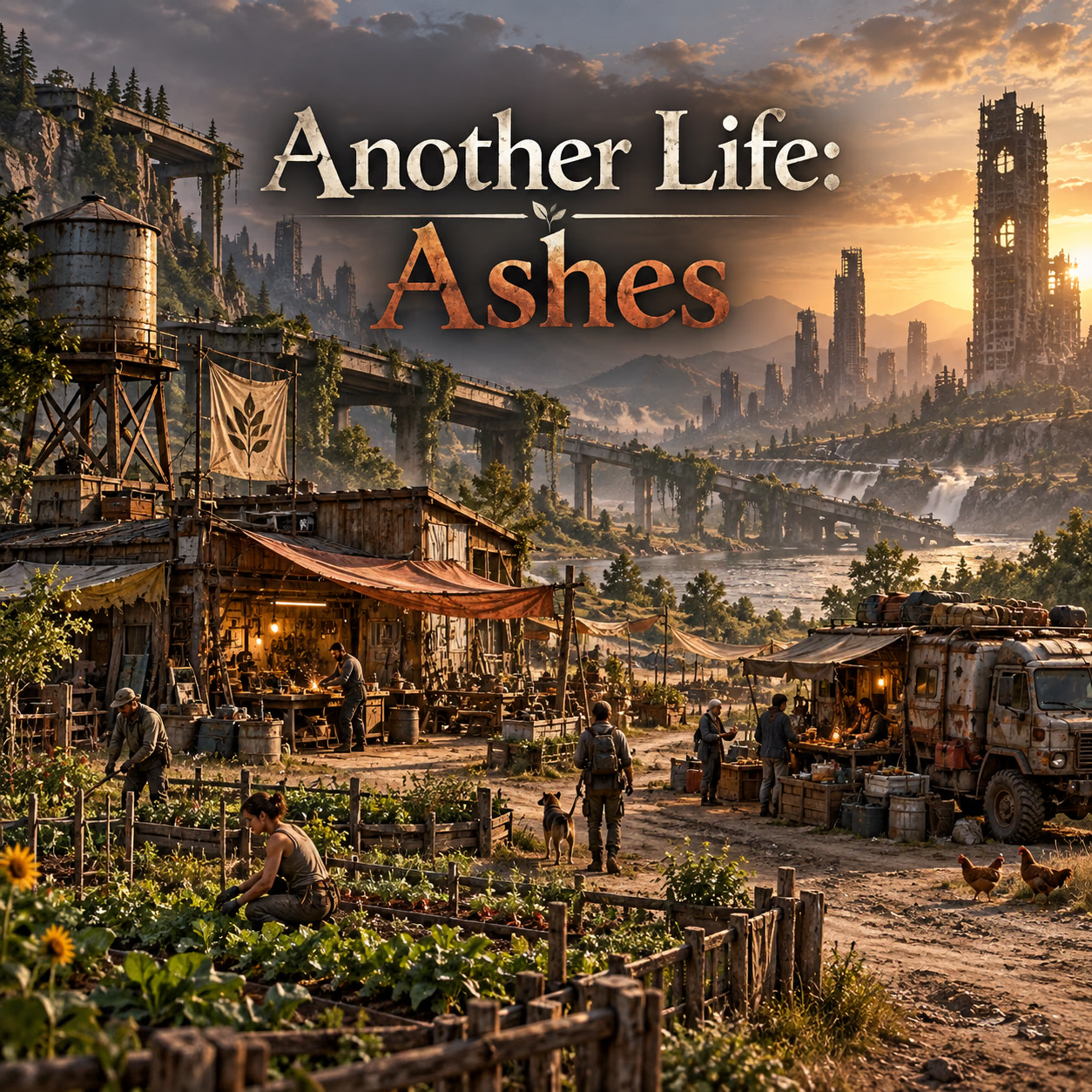
Another Life: Ashes
Another Life: Ashes
The world ended. Life didn't.
Grow food where a highway once stood. Repair machines nobody manufactures anymore. Trade medicine between settlements. Search ruins for something useful. Drive a caravan across broken roads. Protect a community. Exploit one. Build a clinic. Open a bar. Start a family. Lead a settlement. Avoid leadership entirely.
Spend years wandering.
Or stay in the same valley for the rest of your life.
You do not have to save civilization.
You do not have to find the cure.
You do not have to rebuild the old world.
You just have to live after it.
There is no predetermined protagonist, mandatory wasteland war, chosen survivor, fixed faction, or required ending.
The world ended before you arrived.
People adapted. Communities formed. Roads disappeared. New roads replaced them. Old buildings collapsed. Others became homes. Some knowledge survived. Some was forgotten.
And somewhere, somebody planted something.
Choose how your life begins🏚 The Settlement — home, community, work, family, local politics, and long-term growth.
🎒 The Scavenger — salvage, ruins, recovery, useful materials, and old-world remains.
🚚 The Caravan — trade, transport, passengers, routes, news, and connection between settlements.
🔧 The Maker — repair, engineering, fabrication, construction, and practical knowledge.
🌱 The Grower — farming, livestock, water, food production, and stability.
🩺 The Healer — medicine, pharmacy, surgery, healthcare, and access.
🔥 The Hard Road — raiders, mercenaries, armed groups, protection, crime, and violence.
📡 The Keeper — archives, radio, education, maps, records, research, and preserved knowledge.
🛣 The Wanderer — travel, exploration, courier work, exile, migration, and finding somewhere to belong.
✦ Blank Canvas — ignore every preset and begin exactly how you want.
Optionally guide the tone with Survival / Rebuilding / Exploration / Conflict / Community / Prosperity / Mixed.
These are directions, not locked modes.
Scarcity mattersNot everything is available everywhere.
A farming settlement may have food but little medicine.
An industrial town may have machinery but poor water.
A trade hub may have nearly anything—for a price.
Scarcity is contextual.
Salvage mattersOld technology survives in different states.
Some still works.
Some can be repaired.
Some is useful only for parts.
Finding a working refrigerator compressor may matter more than discovering a weapon.
Trust mattersThere is no universal morality meter.
People remember who kept promises, stole, shared food, abandoned someone, repaired something, brought medicine, or started a fight.
Trust is local.
Settlements changeA camp can become a village.
A village can become a town.
A generator is repaired.
A road is cleared.
A weekly market becomes permanent.
A new generation grows up without remembering why the world collapsed.
Recovery is possiblePost-apocalypse does not mean permanent misery.
Agriculture can improve.
Medicine can become more reliable.
Trade can reconnect regions.
Manufacturing can restart.
The old world is history.
Not a mandatory blueprint.
You are not the center of the wastelandSettlements trade without you. Communities fight and reconcile. People marry. Leaders die. Roads reopen. Workshops expand. Caravans change routes.
A place you knew ten years ago may be nearly unrecognizable.
Or it may have disappeared entirely.
No required path. No correct way to survive.
What will you build from the ashes?