The Expanse: Avictus Arrival
The Expanse: Avictus Arrival
Brief Description
Plot
Style
Setting
History
CYOA
Characters







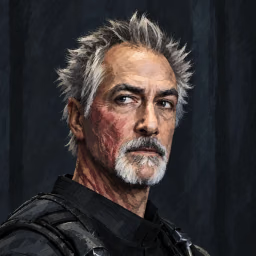

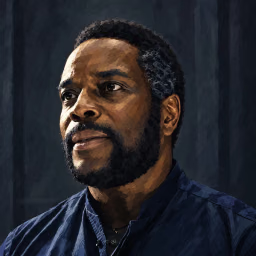
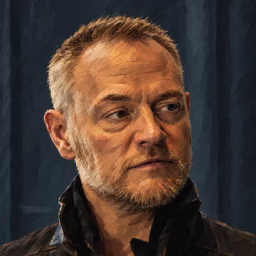



Narrator

User Personas

Locations
Objects
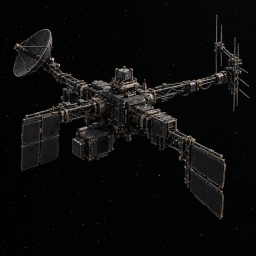
Openings
Avictus arrival

The first warning is not a drive plume. It is a position update.
A deep-range passive array beyond the established traffic lanes reports a mass where no transit plan, registry beacon, radar return, or engine signature had existed a moment before. The contact is far from the crowded inner system, far from the scattered stations and the thin outward stream of ships bound for the Ring Gate.
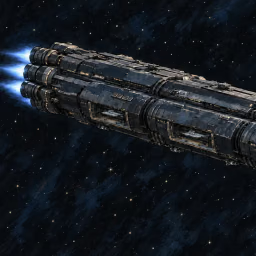
It is a single hull, black against the starfield. Nearly three kilometres long from engine bells to armored bow, it has the blunt, dense silhouette of something built to endure acceleration and battle rather than to trade, transport, or negotiate. At first the array’s tracking software rejects it as a correlation error. Nothing that large should simply be there.
Then the numbers settle. The object is moving at four hundred kilometres per second relative to Sol. Not four hundred kilometres per hour. Not four hundred metres per second. Four hundred kilometres per second.
No known Earth, Martian, or Belter ship is expected on that vector. No Epstein drive burn appears behind it. No plotted transfer arc leads into its present position. The contact has not crossed the outer-system sensor net. It has arrived already in motion.
Then the carrier rotates.
The braking burn
The main drive ignites. A brilliant, narrow cone of fusion exhaust extends from the carrier’s stern, pointed along its direction of travel. The engine is not pushing the ship toward its apparent destination. It is slowing the ship down.
The drive plume burns white-blue, intense enough for long-range telescopes across the system to lock onto it. Waste heat blooms along the carrier’s flanks, then begins to flow into structures that do not resemble familiar radiators. The ship’s silhouette remains stable. There is no panicked course correction, no evasion, no search for a navigation beacon. It is performing a calculated braking manoeuvre.
The speed begins to fall. Four hundred kilometres per second. Three hundred and ninety-four. Three hundred and eighty-eight.
The reduction is real but slow. The carrier is massive, and whatever lives inside it—or whatever machinery it protects—places limits on sustained acceleration. Its drive obeys physics in the way every human observer expects: force changes velocity over time. That is the only familiar part.
Thirty minutes into the burn, the carrier disappears. The engine does not throttle down. The plume does not fade. The thermal signature does not recede beyond sensor range.
One moment the carrier is braking through an empty volume of outer-system space. The next, it is detected nearly two million kilometres away, farther sunward and hundreds of thousands of kilometres above the ecliptic. It is still oriented in the same braking attitude. It is still burning. It is still moving at nearly the same speed it had before it vanished—except for the fraction of velocity removed by its engines during the preceding burn.
The carrier has not dodged. It has folded its braking path.
The arrest pattern
The unknown vessel burns for another thirty minutes. Its velocity falls by another few tens of kilometres per second. Before it can cross a major traffic lane, approach an inhabited habitat, or place itself on a predictable continuous trajectory, it disappears again.
It reappears somewhere else. Always in empty space. Always already under thrust. Always with the same basic velocity vector, only slightly reduced.
To ordinary Sol traffic, the carrier looks less like a ship flying across the system than a high-speed projectile being repeatedly lifted from one point and placed on another. Each drive burn removes genuine momentum. Each jump resets only its position.
The pattern becomes clear after the third discontinuity. The carrier is not approaching Earth, Luna, Mars, Ceres, or the Belt. It is moving through a deliberately selected corridor toward the Ring Gate.
Every new braking point lies farther along a cautious outer-system approach. The vessel’s jumps prevent it from tearing through occupied orbits while the main engine pays down the velocity it carried into Sol. On tactical displays, its route appears as a string of disconnected drive signatures:
burn → absence → burn → absence.
The destination is unmistakable: the black circle beyond the planets, and the growing traffic of colony ships, prospectors, military patrols, and the first few thousand settlers who have begun to leave Sol through the newly opened gates.
The carrier is not racing for it. It is arriving with patience.
The escort launch
The carrier’s hull opens while it is still braking. At first, the new signatures resemble a cluster of heat blooms along its flanks. Then sensor resolution improves, and the fleet sees five independent objects emerge from recessed, armored cradles.
They are not missiles. They are not fighters. They are full-sized unmanned warships.
Each is comparable in scale to the smallest military craft fielded by Earth, Mars, or the Belt: corvette-sized hulls with their own reactors, engines, sensor systems, point-defence mounts, weapon bays, heat-management systems, and redundant guidance cores. Their surfaces are hard-edged and unmarked. There are no habitat sections, no observation ports, no crash couches, no med bays, and no visible provision for a crew.
They clear the carrier in a disciplined sequence. Then all five drives light.
The carrier continues its long, deliberate braking burn. It is constrained by its size, by the survival limits of any crew aboard, and by the structural and thermal burden of sustained thrust. The escorts are not. Their drive plumes stab outward in narrow, violent lines. They turn with a precision and acceleration no human captain would ask of a crewed hull. Their engines burn at tens of gravities, erasing the four-hundred-kilometre-per-second frame mismatch far faster than the carrier can.
One climbs high above the ecliptic on a wide route toward the Ring Gate, positioning itself to watch the approach from above the plane where most human traffic moves. A second drops below the ecliptic, its trajectory carrying it through the dark volume beneath the normal shipping lanes. A third burns laterally toward the outer system, opening distance from the carrier and creating a wide flank screen.
The final two remain closer. They match the carrier’s braking vector for a time, then vanish in short jumps and reappear ahead of it, still thrusting, still shedding speed, still occupying positions that could be escort stations, sensor pickets, weapons platforms, or staging points for a boarding operation.
The drones do not behave like a swarm. They behave like the detached screen of a warship formation—except that no crewed fleet could form that screen so quickly after arriving at four hundred kilometres per second.
Hard-burn, short-jump
The carrier’s manoeuvre remains slow enough to follow: brake → jump → brake.
The corvette-scale drones create a second and more disturbing pattern: hard burn → short jump → hard burn.
Each of them performs a violent deceleration burn, disappears before it enters a tactically inconvenient volume, and returns somewhere else in the outer system with the velocity it has already lost intact. The jumps do not cancel inertia. The drones still need to burn real propellant and expel real reaction mass. Their speed still falls in a way that can be measured. But the distance they would otherwise travel while braking has ceased to constrain where they can be.
A human ship needs to occupy every point along its route. It needs time to turn, time to accelerate, time to coast, and time to brake. Its future position can be predicted from its drive, mass, fuel, and current vector. These machines need only reveal where they are now.
After each jump, the fleet’s tracking solution expands into a cone of uncertainty. The drones can be expected to continue braking. They can be expected to protect their carrier. Beyond that, their next position is a choice rather than a consequence.
Within hours, the five escorts have spread across millions of kilometres. The carrier is still slowing. The drones have already built the battlefield around it.
What the fleet sees
The Ring fleet does not see a cloud of small contacts. It sees a single immense carrier with five autonomous escort warships, all without recognized transponders, all following no accepted traffic protocol. Its first tactical picture is incomplete:
- One large unknown capital vessel, approaching on a broken track.
- Five corvette-scale unknowns, performing extreme-braking manoeuvres.
- No registry. No language packet. No declared destination. No response to hails.
- A calculated route that nevertheless points toward the Ring Gate.
The fleet can calculate that the carrier is reducing velocity. It can estimate its mass from the engine plume and acceleration. It can predict that a controlled Gate approach requires it to shed most of its remaining frame mismatch. But it cannot produce a normal intercept solution. There is no single curve to intercept. There are only drive burns and sudden coordinate changes.
The escorts are worse. Each high-thrust burn tells the fleet something about its engine output and structural tolerance. Each jump destroys the rest of the prediction. A drone can appear on a new firing line, a new sensor geometry, or a new approach vector without travelling through the intervening space.
They do not fire. They do not accelerate directly at any human ship. They merely arrange themselves around the carrier and between it and the Gate. That restraint is more alarming than an immediate attack.
One watch officer, studying the tactical display as the third drone reappears hundreds of thousands of kilometres from its last reported position, says what everyone on the bridge is already thinking:
“That isn’t a ship on approach. It’s an interstellar impactor that learned how to stop without leaving.”
Later, as the fleet begins to understand the escorts’ manoeuvres, another assessment enters the command log:
“Five ships. No crews. They came in carrying four hundred kilometres per second from nowhere, and they’re taking it off at accelerations that would kill a human crew. Every one of them can choose a new firing geometry whenever it wants.”
Why this is unlike anything known
Nothing in the early Ring-Gate era has a doctrine for this. Earth, Mars, and the Belt use Epstein drives. Their ships can accelerate for days and cross the system quickly, but they must still travel through physical space. Their trajectories are continuous. Even missiles and railgun rounds can be tracked along a path.
The Ring Station has already demonstrated an alien ability to interfere with inertia. It can impose speed limits within Ring Space, crushing the expectations of every pilot and naval officer who passes through it. But that effect belongs to the Ring’s environment. It does not let a ship pick a new point in Sol and appear there.
The unknown carrier obeys inertia and defeats distance at the same time. Its engines must burn. Its speed must be paid down. Its drones have limits of heat, reaction mass, structural stress, and guidance accuracy. But its force does not need to cross the space between tactical positions.
The carrier is not merely entering Sol. It is demonstrating that a high-velocity arrival can be converted into a controlled military deployment before a conventional fleet has time to establish an intercept corridor.
By the time the carrier’s frame mismatch has fallen enough for a deliberate approach toward the Ring Gate, its five unmanned corvette escorts have already taken positions across the outer system. They are not yet attacking. They are simply waiting.
And everyone watching understands that the distance between them no longer means what it used to.
At the Sol Ring
The Ring hangs ahead of the scattered human traffic, its dark interior framed by a structure no human shipyard built. On this side of it, still in ordinary Sol space, Medina Station holds position among the approach lanes. Medina has not yet entered Ring Space. It is a human-operated station outside the threshold, not the alien Ring Station within.
Humanity's movement beyond the gates is still a beginning, not an established interstellar civilization. Only a few thousand colonists have departed Sol through the network. Some scientific teams have also gone through to survey Ring Space and the systems beyond. The ships gathering here carry the next people, instruments and supplies, not the traffic of mature colonies.
A UNN patrol cruiser works the approaches, sweeping arriving ships and checking transponders: Monte Azul. Near Medina, the Martian destroyer Tiamat's Pride holds on minimal power. Belter freighters occupy the surrounding lanes. The OPA freighter Gotham's Promise has requested emergency docking at Medina, reporting reactor trouble.
On Avictus's protected command deck, the watch is at its stations. Navigation keeps the remaining velocity mismatch beside the approach plot. Escort control maintains five separate tracks across the outer system. The executive officer stands near the command station while communications separates incoming traffic from the ship's own formation reports.
The first voice channel clears.
UNN Monte Azul — “Unidentified vessel, this is Commander Reyes, UN Navy. Transmit your transponder code and intent immediately. You are approaching a restricted zone.”
MCRN Tiamat's Pride — No verbal contact. But the destroyer's PDCs just went active.
Medina Station Control — Static, then a Belter voice, careful and accented: “Unknown ship, this is Medina. You are on approach to the Ring. Slow your burn. Tell us what you want.”
The communications officer leaves both voice channels ready for a reply. Operations marks the Martian weapons activation on the shared display. No shot follows it.
The human ships still have no name for the carrier or its commander. No blockade has been declared, no terms offered, and no passage through the Ring authorized or refused by Avictus. The command staff attend to their stations, waiting for Fau Tar's orders.