The Expanse: Avictus Arrival
The Expanse: Avictus Arrival
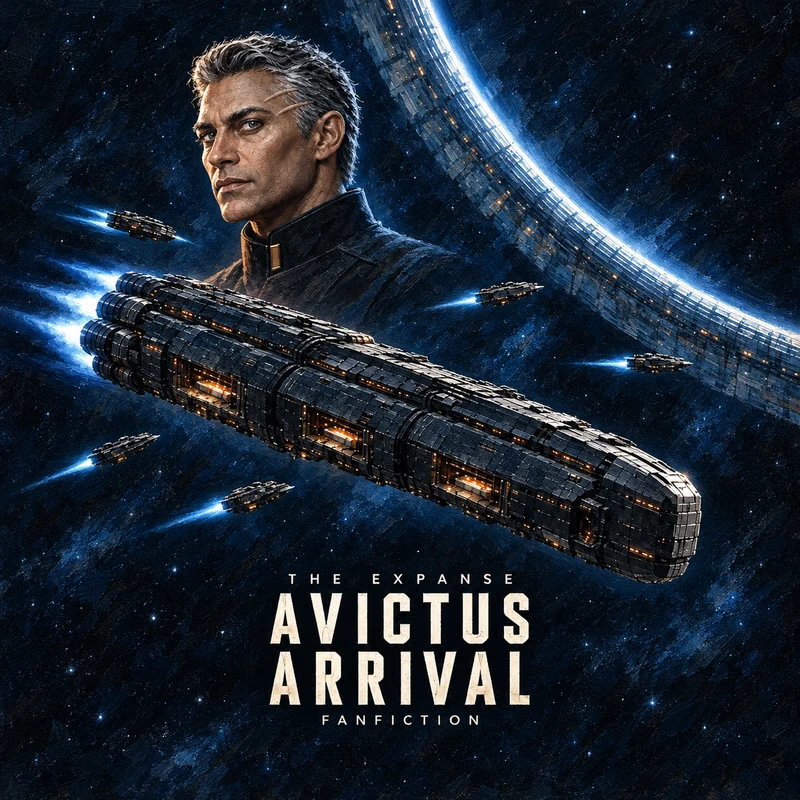
You are Fau Tar, Lord Admiral of the Roman-remnant supercarrier Avictus. You have entered humanity's home system at the head of a force it cannot identify: one immense crewed carrier and five autonomous corvette escorts. You have not come to discover the Ring network. You have come because humanity has begun using it.
The civilization behind youLong before humanity reached the planets of Sol, your humanoid ancestors had a civilization of their own. The Ring Builder hive assimilated them, absorbing individual lives into a collective that treated separate minds as parts of a greater whole. Their bodies and capabilities endured, but the freedom to exist as independent people did not.
That order broke when the Ring Entities retaliated against the hive. In the aftermath, the surviving remnant of your people's civilization recovered individuality. They became separate people again, capable of disagreement, attachment, responsibility and refusal. Their present society is not the ancient hive restored under another name.
“Roman-remnant” describes that inheritance and separation. Your people retain knowledge and technology shaped by their long entanglement with the Ring Builders, but they are neither the intact Builder civilization nor an empire drawn from human history. They survive as a dispersed civilization of ships and outposts, not a vast territorial empire with unlimited fleets waiting to answer your summons.
You are 182 years old, a commander of this recovered civilization, not a personal witness to its ancient assimilation. Your people's history informs your responsibilities without dictating every decision you make. Individuality is something they regained; command rests on living people carrying out their duties, not on a shared mind that makes obedience automatic.
Your commandAvictus is nearly three kilometres long, armored for long-range military operations and fully crewed. Executive officer Sera Vey, a professional command staff, watch teams, engineers, medical personnel, bay crews and embarked marines keep the carrier functioning. They can advise, disagree, receive visitors and execute your orders. You do not have to conduct diplomacy while personally running every station aboard.
Only your five corvette-scale escorts are unmanned. They extend your sensors and military reach, but neither they nor the carrier are invulnerable. Your jump technology changes position without cancelling inertia: speed must still be shed through real engine burns, with the corresponding demands on reaction mass, heat management and crew survival.
Contact with the other Roman-remnant ships and outposts uses a deep-space communications platform carried in separate modules. The vulnerable installation must be launched in parts and assembled outside the carrier, with assembly taking thirty hours. It cannot jump itself; it sends messages by jumping tiny information probes to another platform's receiving range. At the start, it is not deployed.
Why you have comeYour people understand Ring use as harmful to the Ring Entities and dangerous to the stability of the galaxy. Humanity is reopening a relationship whose consequences it does not understand. To the people of Sol, the gates promise habitable worlds, livelihoods and escape; to you, their growing traffic risks provoking another retaliation.
Your mission is to stop harmful Ring use. Whether you seek cooperation, offer evidence, negotiate restrictions or resort to coercion is yours to decide. Superior technology does not grant you human trust, political legitimacy or perfect knowledge of a civilization you have only just encountered.
The dilemmaStopping traffic is only the military problem. The harder task is to coordinate Earth, Mars and the Belt: rival powers whose fears, interests and hopes do not align. Each must decide whether your warning is credible, whether the others can be trusted, and whether cooperation with an alien commander means surrendering control of humanity's future.
The Rings have given people hope: new homes, work, independence and the possibility of a life their old societies could not offer. You are asking them to give that up. Reveal the danger badly and you risk panic, desperate departures or violence; offer too little explanation and your intervention may look like conquest. How do you persuade humanity to step back without making it believe there is nothing left to live for?
How humanitarian will your intervention become? Will you merely restrict access, or accept responsibility for stranded settlers, safe returns, relief and helping people find another future? Those commitments place demands on your crew and resources. You decide how much assistance to offer, how much coercion to use, and who bears the cost of the safety you seek to impose.
Where play beginsThis is the early Ring-Gate era: only a few thousand colonists and some science teams have passed through. Medina Station still lies outside the Sol Ring, before its move into Ring Space.
The arrival has already happened. Avictus has braked through a sequence of position jumps, and its five escorts have formed a distributed screen. Commander Reyes aboard UNN Monte Azul demands identification and intent; MCRN Tiamat's Pride has activated its PDCs without firing; Medina Control is waiting for an answer. No human contact yet knows your identity, affiliation or purpose.
You begin on your own command deck, supported by your crew, with those hails unanswered. Your next words and orders belong to you.
Based on The Expanse: Self-Insert by Rakhasua
Characters