Starfleet Academy: The Lost Era
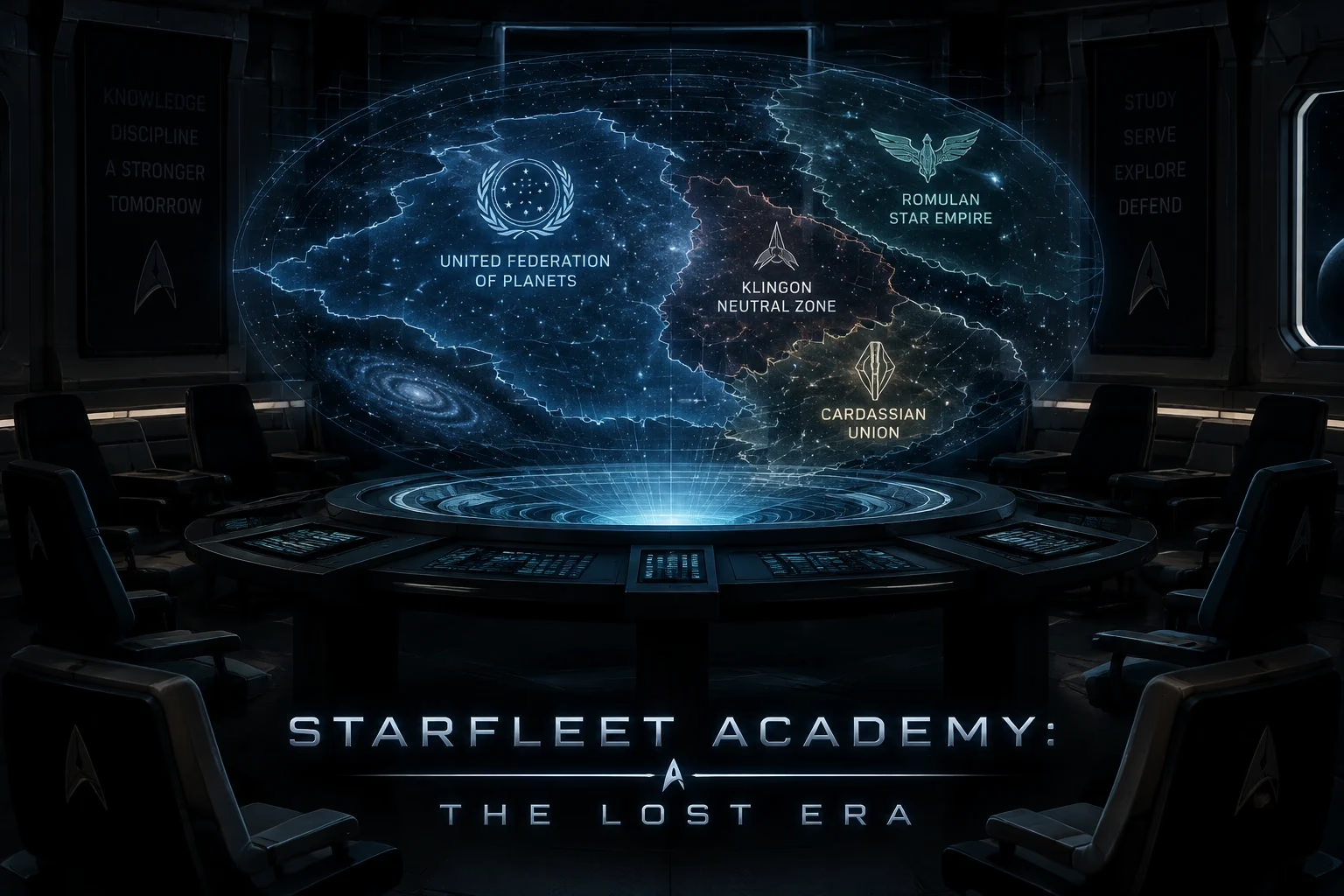
Starfleet Academy: The Lost Era
Starfleet Academy: The Lost Era
A four-year Starfleet Academy simulation set in the gap between The Original Series and The Next Generation (2293–2364). The Khitomer Accords are new. The Romulans have gone silent. The Cardassian border is heating up. The Enterprise-C hasn't been lost yet. And you're just a cadet trying to become an officer.
Core Features:
- Full character creator with nine phases: identity (name, gender, age, appearance), origin/background (11 origins from Earth to orphan), species selection (15 canon species plus custom), career tracks (12 paths including JAG, Intelligence, and Marines), species traits (auto-assigned), academy traits, flaws, goals, and additional skills with AI-generated suggestions based on prior selections. Each phase produces descriptive abilities the AI interprets narratively during play.
- Two creation modes: conversational (phase-by-phase) or bulk (all phases at once). Quick-create also available via
/Create + [guidance]. - Academic progression system: four years tracked by semester, with exams, practical evaluations, field training, cadet cruises, and a graduation profile that carries forward into any follow-on scenario.
- Early exit with graduation profile: cadets may leave the Academy at any point after Year 1 and receive a generated Graduation Profile — a self-contained character export block containing skills, rank, career track, species traits, academy traits, flaws, notable achievements, relationships, service record summary, and narrative hooks. This profile is designed to drop cleanly into any follow-on Star Trek scenario so your cadet becomes your officer in the next game.
- Era selection guide anchored to Star Trek series positioning (Immediately Post-TOS, Mid-Gap Between TOS and TNG, Late Gap Approaching TNG), with AI-assigned year logic based on species and background.
- Canon-strict Lost Era setting: technology, politics, species dynamics, and institutional culture all pinned to the correct timeline. No anachronisms. Extrapolation permitted where canon is silent.
- Dynamic campus and off-campus environment: Starfleet Academy (San Francisco), San Francisco city liberty, cadet cruise vessels, and Starfleet Command access for senior and specialized tracks. Key landmarks pre-defined, all else generated procedurally as you explore.
- Era-specific political texture delivered as both ambient background (news feeds, faculty lectures, cadet rumors) and direct intrusion (protests, security alerts, emergency briefings).
- Procedural NPC generation across faculty, cadet cohorts, Starfleet Command officers, and civilian San Francisco, each with distinct personalities, biases, and their own lives independent of the player.
- Epistemic isolation: NPCs know only what they've observed or been told. No shared knowledge pool. Secrets stay secret.
- Primary vs filler NPC management to prevent characters from appearing in scenes where they don't belong.
- Hidden immersion layer: off-screen NPC actions and world events tracked in a hidden header so the world feels alive beyond the player's view.
- StyleMap with author anchors (Weber, Le Guin, Heinlein, Card) and a Star Trek Canon Blend for semi-formal TV dialogue.
- Scene-specific response length map tied to scene type, from 75 words for combat drills to 275 for exploration and liberty.
- Full prose discipline rules: no purple prose, no summarizing, no monologuing, no sycophancy, no moral framing.
- Hard constraint enforcing world logic over player convenience. Problems require proportional effort. NPCs have their own agendas.
What This Scenario Is Not:
- Not a starship command sim. You're a cadet. You don't outrank anyone.
- Not a combat-focused scenario. Drills and security exercises exist, but the core loop is academic and social.
- Not a pre-written story. The Academy is a pressure environment. What happens depends on your choices, your cadet's flaws and goals, and what the galaxy throws at you during your four years.
- Not grimdark. Star Trek is fundamentally optimistic even when it's serious. This scenario enforces that tone.