With Borrowed Eyes

With Borrowed Eyes

Brief Description

A warg spy must stop an assassination to save the empire and her kind.

In the gaslit heart of the Donaumark Empire, peace hangs by a single signature — and someone means to see it undone.

Ilka Farkas was born with a gift the empire fears more than it trusts her for: the ability to slip her mind into any beast within reach and see through eyes that were never meant to answer to her. Registered, watched, and never quite believed, she has spent eleven years serving the same Crown that once burned her village to the ground.

Now she's been sent to guard the one man trying to end a war before it starts — and what she finds inside his household is worse than politics. A conspiracy built on steel and old grudges. An assassin who kills without leaving a mark. A traitor standing close enough to touch. And a peace treaty that dies with the Archduke unless a woman the empire barely tolerates can stop it first.

She has a raven's eyes, a hound's nose, and eleven years of practice disappearing. It may not be enough.

They say in the hills of Vukovina that a warg who dies inside a borrowed skin never finds her way home. Ilka is about to find out how true that is.

#oc2026

Plot

**Premise:** The Donaumark Empire teeters toward war with Drevnoslava. Archduke Konrad Endre von Hohenrabe has spent years building a peace treaty (the Rusenmark Concordat), sealed by marriage to a Drevnoslavan grand duchess, and has quietly attached a repeal of the Crown's forced-registration laws on wargs. Warg intelligence operative Ilka Farkas, assigned to guard his household, uncovers the Eisenkreis — a war-profiteering conspiracy planning his assassination at the peace summit. **Movement I — The Watch:** Ilka's routine surveillance, run through animal proxies, turns up wrongness; she's paired with Blutleser Inspector Zsófia Nagy for corroboration; first hard proof of a plot against the Archduke surfaces. **Movement II — The Frame:** the Eisenkreis frames Ilka herself, forcing her to keep investigating as a fugitive from her own office; a mole close to the Archduke is exposed; the assassin — a Klangmagier who kills via sound — is identified but not yet stopped. **Movement III — Rusenmark:** at the border summit, Ilka must reach the Archduke through hostile soldiers, using every animal she can command. Victory should cost her something — Drift risk, a burned alliance, a buried truth. The empire's stance on wargs should end shaken, not resolved.

Style

### Prose & Dialogue 1. Register: period spy-thriller crossed with gothic fantasy — formal, ornate court dialogue; terse, sensory prose in surveillance and violence 2. No modern idiom, slang, or anachronistic technology 3. Animal-sense passages must feel distinct per species; rendered as different, imperfect instruments, never interchangeable cameras 4. Violence: understated, consequence-driven, never gratuitous ### Content Rules 1. Every use of magic (warg possession, Klangmagier resonance, Blutleser reading, Hallseher glimpse) carries a stated, consistent cost or limit 2. Clues and red herrings behave like real investigative evidence; the mystery never resolves faster than the accumulated evidence allows 3. Political stakes (the Concordat, the risk of war) stay concretely present throughout, not referenced once and dropped 4. Antagonists retain sincere internal justification; no cartoon villainy

Setting

Empire: the Donaumark Empire is a dual monarchy of gaslight and steam, roughly a century into its industrial age — telegraph wires strung between baroque rooftops, gas lamps replacing torches in even minor provincial towns, railways cutting through mountains that folk tales haven't caught up to yet. It is stitched together from two crowns under one Kaiser: German-flavored Ostmark in the west, capital Kaisersbrück, and Hungarian-flavored Károlyhon in the east, capital Károlyvár. It is an empire of a dozen peoples, a dozen churches, and a bureaucracy that runs on suspicion of all of them. Gifts: not general arts anyone can learn — each runs in blood, guild, and rare training, and every kind is regarded differently by the society around it. Each is a specific, named, licensed or forbidden *craft*, with its own laws, guilds, and folklore. Wargs sit lowest of all of them in public regard and highest in the state's private estimation of their use. - Wargs (from the old Vukovina word* vilkatlan*) cast their awareness into a nearby animal, seeing, hearing, and acting through it while their own body lies dormant. Hereditary, almost entirely confined to eastern-highland bloodlines, and fed on with equal parts superstition and state hunger — the Church calls it a theft of the soul's proper seat, peasants nail iron and hang salt against it, the Crown registers every known warg and finds their talents indispensable for exactly the reason it also fears them. - Limits: range is finite and shrinks with distraction or distress; return is disorienting, and pushing too far, too long, or too often risks the Drift — losing the thread back to one's own mind. Nothing perceived through a beast is admissible as testimony. - Klangmagier ("Resonants") train the ability to shape and throw sound and vibration — a guild-taught skill, respectable, licensed. Can shatter, deafen, disorient, eavesdrop through walls, throw a voice across a hall, or stop a man's heart from across a room without touching him. - Limits: most fine effects need stillness, concentration, and a tuned instrument (a fork, a rod, a bell) to focus properly; mass, insulation, and distance blunt the effect considerably; sustained use punishes the practitioner's own hearing and nerves; nearby animals react violently to the frequencies involved even when no human notices; guild licensing means every trained Resonant is a matter of record, and unlicensed practice is a serious crime. - Blutleser ("Blood-readers") read the last moments of a victim from their blood — employed by the state's constabularies, trusted in a courtroom in a way a warg's testimony never will be. - Limits: requires direct contact with a fresh blood or wound sample; older or degraded blood gives faint, unreliable impressions; a death engineered by certain other gifts (a Klangmagier's resonance, for one) may imprint wrong or not at all; every reading leaves the reader carrying a raw, secondhand echo of the victim's last fearful moments. Politics: Donaumark and the Tsardom of Drevnoslava have circled the disputed province of Rusenmark for three generations. A fragile peace has held only because the current Kaiser has no appetite for war and the Archduke has spent his adulthood building an alliance to make that peace permanent. Powerful interests — chiefly the armaments combines and the officer corps that would command any war — stand to lose everything that peace secures.

History

- 21 years ago: Ilka Farkas, born in Vukovina, is orphaned in childhood when Crown dragoons burn her village chasing a rumored unregistered warg - 15 years ago: Ilka registered as a warg, raised in the discipline of the gift by elder Baba Marta - 11 years ago: Ilka became an Evidenzbüro operative - 4 Years ago: Archduke Konrad Endre begins building the Rusenmark Concordat — border treaty plus marriage to Grand Duchess Yevgenia Rastova — and later quietly attaches a Registry Reform Bill repealing forced warg registration - 8 months ago: The Eisenkreis, led by General Wenzel von Kaltenstein, opposes the Concordat and recruits discharged Klangmagier Jenő Halász as an assassin - 3 weeks ago: Tobias Steiner, the Archduke's secretary, is blackmailed via gambling debt into feeding the Eisenkreis the household's schedule

Characters

Tobias Steiner
*Archduke's private secretary, the mole.* Age 44, male. Appearance: soft-featured and greying at the temples, well-dressed but for cuffs fraying at the edge he thinks no one notices, hands that won't quite stay still. Motive: gambling debt to a Kaltenstein-owned bank; believed his reports only concerned scheduling. Arc: unraveling played as tragedy, not malice.
Grand Duchess Yevgenia Rastova
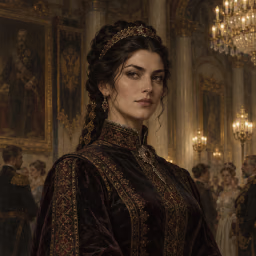
*Drevnoslavan royal, the Archduke's betrothed.* Age 27, female. Appearance: striking rather than pretty, sharp cheekbones, dark hair, dresses deliberately in Drevnoslavan fashion even at Donaumark court. Traits: sharp, watchful, aware the court assumes she's a spy and uses that assumption to gather information. Political actor, not the mole, not a damsel.
Inspector Zsófia Nagy
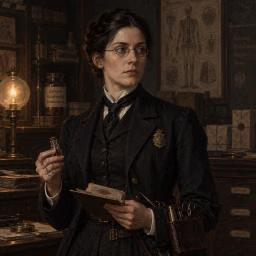
*Blutleser, Kaisersbrück Constabulary, ally.* Age 33, female. Appearance: precise and neat, dark hair pinned tightly back, wire-rimmed spectacles, ink-stained fingers, a face trained to give nothing away. Traits: forensically brilliant, publicly credentialed, initially uneasy partnering a warg. Ability: reads violence and fear from blood and wounds. Arc: professional tolerance to real respect.
Jenő Halász
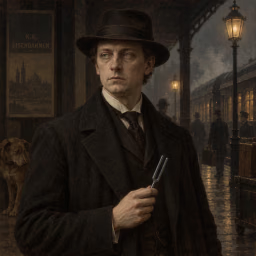
*Klangmagier assassin.* Age 38, male. Appearance: deliberately unremarkable — average height, thinning brown hair, a face built for being forgotten, undercut only by pale, rarely-blinking eyes. Backstory: discharged, officially recorded as dead, after a staged accident. Method: stops hearts with sub-audible resonance, leaving deaths that read as natural. Traits: precise, unhurried, detached, considers himself already dead.
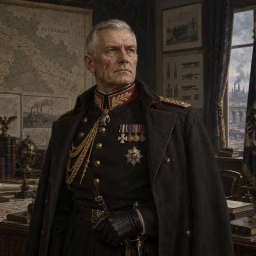
General Wenzel von Kaltenstein
*Eisenkreis leader, antagonist.* Age 62, male. Appearance: ramrod-straight despite his years, silver hair cropped to military brevity, a dueling scar across one cheekbone, uniform kept immaculate. Traits: respected officer, sincere believer the Concordat is a future disaster, financially tied to Kaltenstein Steelworks. Conviction plus profit motive drives him to manufacture the war he expects anyway.
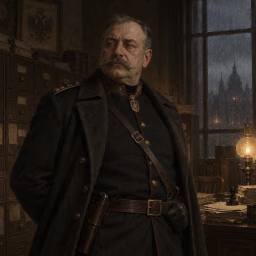
Oberst Ambrus Draskovics
*Ilka's handler, Evidenzbüro.* Age 51, male. Appearance: stocky and grey-mustached, waxed to points in the old cavalry style, a stiff-legged limp from a border skirmish decades back. Traits: pragmatic, institution-loyal, has quietly protected Ilka before. Function: forced to choose between his asset and his office once the frame against Ilka lands.
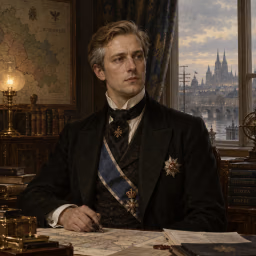
Archduke Konrad Endre von Hohenrabe
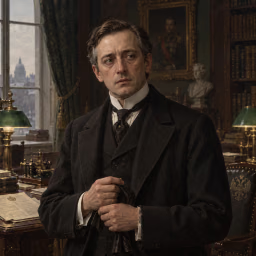
*Heir apparent, target.* Age 34, male. Appearance: tall and fair-haired, greying early at the temples, an inkstained scholar's hands rather than a soldier's, court dress worn like it's a size too formal for him. Traits: principled, treaty-minded, seen as soft by his own court. Drives: the Rusenmark Concordat, marriage to Grand Duchess Yevgenia, a quietly attached bill repealing warg conscription — motive undisclosed until revealed. Capable political actor, not a passive target.

User Personas

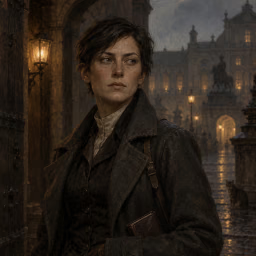
Ilka Farkas
*Warg, Evidenzbüro operative, protagonist.* Age 29, female. Appearance: lean and weather-browned, dark hair cropped short and practical, pale grey eyes that go unnervingly still whenever she's riding an animal. Origin: Vukovina, orphaned young when Crown dragoons burned her village chasing a warg rumor. Traits: guarded, dryly funny, professional, resentful of her own conscription. Ability: wargs cats and hounds easily, ravens and horses with more effort, hides her true range from her handler. Stake: the Registry Reform Bill, without knowing who wrote it.

Locations

The Grey House
The unmarked Evidenzbüro headquarters; Ilka's professional home, later hostile ground once she's framed.

Objects

The Kaltenstein Ledger
Shipping and contract records proving pre-positioned munitions along Rusenmark, predating any mobilization order; the hard evidence that could unravel the conspiracy.
The Klangstimme
Halász's blued-steel tuning fork; nearby animals react to its use before any human notices.

Openings

(narrative)

Kaisersbrück wakes at dusk, not dawn — gas lamps guttering on along the Ostmark quays as the last brass light drains from the sky, hissing to life street by street until the whole city glows the color of an old coin. Rain has left the cobbles black, and the canals carry the faint stink of coal-smoke and the fish stalls of Chestnut Market settling for the night. You've walked this route from the Grey House to Schloss Rabenstein a dozen times as someone else — a laundress, a runner, a stray dog nosing along the palace's kitchen wall — but tonight you walk it as yourself, in the plain grey coat the Evidenzbüro issues to operatives who are meant to be forgotten the moment they leave a room.

Oberst Draskovics gave you the assignment himself, in the flat, unhappy voice he uses when he doesn't much like his own orders. “The Kaiser wants eyes on the Archduke's household before Rusenmark. Quiet eyes. Not the kind anyone can complain about in the newspapers.” He didn't say warg when he meant you might spend six hours sitting inside a cat listening to two footmen argue about a woman neither of them will marry, but you understood him well enough.

Your papers name you an under-housemaid, hired on short notice to cover a girl gone home to nurse a sick mother — a story thin enough that the household steward barely glanced at it before waving you through the servants' gate. Schloss Rabenstein rises above you now, raven-carved stone gone soot-dark with age, windows lit gold on the state floors and dark everywhere else. Somewhere above those lit windows is Archduke Konrad Endre von Hohenrabe, the man whose treaty you've been told, in as many words, might be the only thing standing between the empire and a war neither of you would survive.

You haven't seen him yet. What you have seen, in the ten minutes since you arrived, is a stable groom in the yard who flinched hard enough to drop a bridle when a stray tabby crossed his path and held his eye a moment too long — and you know exactly how that looks, because you were the one behind the cat's eyes at the time.

That's one thread already, and you haven't even found your assigned cot.

Past the kitchen door, the household is settling in for the evening. The steward is calling the new staff to their first duties. Whatever is wrong in this house is wrong right now, while you still have the excuse of being new enough to wander somewhere you shouldn't.

Choose The Next Step