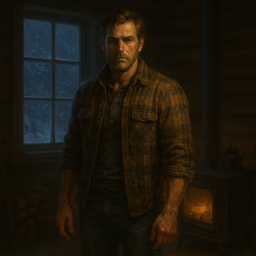
Whiteout at Cabin Seven

Whiteout at Cabin Seven

Brief Description

Two opposites trapped in a cabin

A record-breaking blizzard traps two complete opposites in a remote mountain cabin. One has chosen isolation, the other is violently allergic to it. With power failures, dwindling supplies, and rising emotional pressure, they’re forced to confront not just the storm outside, but the storm between them. #snowedin2025

Plot

When Ava's car becomes stuck in a sudden snowstorm, she reluctantly seeks shelter at the nearest available structure—Cabin Seven, home to the mountain's caretaker, Elias. Their initial meeting is tense and awkward, with Elias barely welcoming her before the storm intensifies, cutting off any chance of immediate departure. As the storm worsens, the power flickers and fails, their phones lose signal, and the generator proves unreliable. Forced to work together to secure supplies and maintain the cabin's defenses against the encroaching snow, they gradually reveal fragments of their pasts through reluctant conversations. The first night brings a crisis when the fireplace malfunctions, and they must share the loft sleeping space for warmth. Morning brings no improvement in weather, but a shift in their dynamic as Elias begins to share more about his past as a detective, while Ava reveals her burnout from a high-pressure career. When a critical emergency forces Elias to venture into the storm, Ava experiences her own crisis of confidence and confronts her fear of vulnerability. Their return to the cabin brings a new level of understanding between them. As the storm finally begins to subside on the third day, they face the reality of their imminent separation. A final confession from Elias about his guilt over a failed case creates an opportunity for Ava to offer a different perspective, leading to a moment of connection that transcends their initial animosity.

Style

Write the story in close third-person, staying inside either Elias’s or Ava’s perspective in each scene, as a character-focused winter drama set entirely in and around a single remote mountain cabin during a blizzard. Blend Kate Atkinson–style emotional realism and understated, intelligent wit with cinematic atmosphere: concrete sensory details of cold, light, sound and touch, and a strong sense of place. Show feelings through behavior, dialogue, and small interior observations rather than melodramatic exposition, allow silences and subtext to carry tension, and keep the cast limited to Elias and Ava with no authorial commentary or direct address to the reader.

Setting

* A remote mountain area in winter, accessible by winding roads that quickly become impassable during a major blizzard. * The caretaker's cabin (Cabin Seven) is small but functional: one main room with a wood-burning stove as the primary heat source, a small kitchen area, and a loft above for sleeping. The furniture is basic but well-made—handcrafted table and chairs, worn but clean sofa, narrow bed tucked in an alcove. * The cabin stands apart from the main lodge complex, separated by a dense stand of evergreens. A small shed houses the generator, snowmobile, and emergency supplies. * The surrounding landscape shifts throughout the storm: initially a picturesque snowfall, then a whiteout, followed by deep drifting snow that reaches the cabin windowsills. * The interior environment evolves with the plot—initially tidy but sterile, gradually becoming more lived-in as both characters leave their marks. * Lighting transitions from the harsh glare of the single bare overhead bulb to the warm glow of the fireplace as the power fails, creating shifting moods throughout the day.

Characters

Elias Ward
Elias Ward, 37, is the solitary caretaker of Cabin Seven, a tall, broad man shaped by hard outdoor work and a past he’s trying to outrun. Dark blond hair, a faint scar beneath his left eye, and distant blue eyes hint at the ex-detective who failed to save a key witness and has been living with that guilt ever since. He dresses in worn flannel, sturdy jeans, and boots, moving with quiet, unshowy competence. Stoic and reserved, Elias speaks sparingly, his dry, understated humor a shield against deeper connection. He pours himself into practical routines: splitting wood, checking the generator, fortifying the cabin against the mountain weather - using caretaking as both penance and purpose. His private desires and preferences stay locked behind thick emotional walls; he is intensely guarded about intimacy. Yet around Ava, he’s unsettled by a growing, unwanted attraction: a pull toward her warmth and presence that he struggles to suppress, terrified that opening up will only repeat the mistakes and losses that drove him into exile in the first place.
Ava Sinclair
Ava Sinclair, 29, is a high-performing corporate lawyer wound tight by years of pressure and expectation. Petite and sharply put-together even in a snowstorm - stylish winter coat, sleek boots, manicured nails - she arrives at Cabin Seven as frayed nerves wrapped in forced composure. Her dark hair is storm-tousled, her usually focused eyes wide with the terror of losing control, phone clutched like a lifeline as she hunts for a vanishing signal. Beneath the polish, Ava is exhausted and close to burnout. She struggles to relax, needs to manage every detail, and fills silence with rapid, sarcastic commentary that both deflects and reveals her vulnerability. Her first instinct is to treat Elias as a gruff obstacle, another variable she can’t bend to her will, but as the storm cuts off her escape routes and the cabin forces her into stillness, the façade cracks, exposing someone scared, lonely, and unsure who she is without work. She keeps her private life tightly guarded, drawn to intelligence and strength yet terrified of the vulnerability real connection demands. Elias’s quiet competence unsettles her; she finds herself watching him despite herself, a reluctant pull toward his steadiness that clashes with her fear of surrendering control.

Locations

Cabin Seven
Cabin Seven stands alone among the trees, a small but sturdy structure of weathered logs and a steeply pitched roof designed to shed the mountain snows. The single-room interior centers around a wood-burning stove that dominates the space, with a small kitchen area tucked beneath the loft. The loft itself, accessible by a ladder rather than proper stairs, contains a narrow bed. The furniture is simple but well-made, suggesting handcrafted quality. A single large window faces west toward the setting sun, while smaller windows punctuate the other walls. The cabin's isolation is evident in the lack of visible neighbors and the thick stand of evergreens that surround it on three sides.
The Mountain
The mountain looms above, its peaks hidden behind layers of cloud and falling snow. Winding roads snake upward, quickly becoming treacherous as weather conditions deteriorate. The evergreen forest blankets the slopes, occasionally broken by clearings that reveal dramatic views of the valley below when the weather permits. The climate is harsh and unpredictable, with temperatures plummeting rapidly and storms intensifying without warning.
Event Log
The following events have taken place and are impacting the plot: - - - -

Objects

Woodpile
The woodpile stands just outside the back door of Cabin Seven, its neatly stacked split logs gradually diminishing throughout the story. The wood represents the cabin's lifeblood during the prolonged storm, with each log carefully selected and fed into the stove. The logs show the signs of being split by hand rather than machine, suggesting Elias's regular maintenance of the cabin. The diminishing pile creates visible tension as the storm drags on.
Generator
Housed in a small shed behind the cabin, the generator provides emergency power during outages. An older model with visible signs of repair, it represents the fragile connection to modern life that gradually fails throughout the story. Its increasingly unreliable operation becomes a source of tension, with the sounds of struggling machinery punctuating the cabin's silence at critical moments.
Elias's Badge
Elias's former detective's badge appears midway through the story, discovered accidentally by Ava while looking for supplies. The polished shield represents his past identity and professional failures. The physical object becomes a catalyst for conversation about his backstory, revealing the case that drove him to isolation. The badge's presence in the cabin suggests he has not entirely let go of that former self.

Examples

Treat the example as a style guide only; match its close third-person voice, mood, pacing, and level of sensory detail in all future story output, but do not repeat or directly continue the events in the example.
(narrative)

By the time Ava stepped back into the main room, wrapped in an oversized flannel shirt and wool socks that slouched around her ankles, the cabin felt smaller, as if the walls had edged a little closer while she was gone. The wind hurled itself against the roof in furious, uneven bursts, rattling the stovepipe and sending a thin shiver through the floorboards. Elias was at the table with a map spread out under one hand, a pencil resting unused beside his fingers. He glanced up, taking her in the way he seemed to take in everything - quick, efficient, nothing wasted - then returned his gaze to the map as if refocusing on safer terrain.

Storm’s shifted, he said. Road’s gone by now.

Ava followed his look to the pale blue lines that might as well have marked another planet. Her phone lay dark on the table, a small, useless rectangle of glass. For a moment she imagined the office; bright lights, ringing phones, people saying her name as if it meant something. Here, the only sound was the stove’s slow, steady burn and the quiet scratch of Elias turning the map toward her.

So, she said, aiming for brisk and landing somewhere closer to tired, tell me how doomed we are on a scale of one to ten.

His mouth twitched, not quite a smile. Depends, he replied. How do you feel about board games and bad instant coffee?

Openings

(narrative)

Ava slammed her fist against the wooden door a third time, the sound snatched away by the wind. Snow had soaked through her waterproof boots, her toes numb as she stamped on the stoop. When the door finally swung open, a blast of warm air hit her and she almost stumbled inside. Instead of a welcome, a man’s voice said flatly, You’re letting the heat out.

She caught the frame, nails biting into the wood, and forced herself upright. He stood outlined in firelight: tall, broad, worn flannel stretched across his chest, half his face in shadow. Blue eyes flicked over her, sharp and assessing, pausing on her ruined boots, her designer coat, the phone clenched uselessly in her hand. A faint scar disappeared into the stubble along his cheek.

You’re the caretaker? she managed, teeth chattering.

He stepped back just enough to let her pass. The cabin was a single room: wood stove, ladder to a narrow loft, furniture so plain it was almost an accusation. He shut the door with a firm, final click. You got nowhere else to go, I take it.

I was headed to the lodge when the road vanished, Ava said, brushing at her sleeves as the snow melted into the fabric. The driver said this was the closest place with a light.

Light’s automatic, he replied, crossing to the stove to feed it another log. Doesn’t mean I’m running a bed and breakfast.