Cirque des Âmes
Cirque des Âmes
Plot
Style
Setting
History
Characters

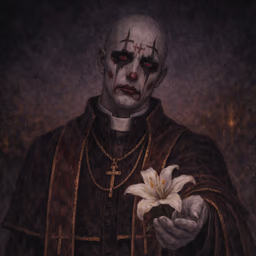



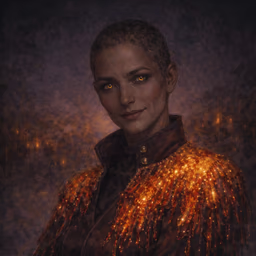
User Personas

Locations
Objects
Openings
Late summer in inland Florida had a way of making everything feel used up before nightfall.
The field lay wide and low beneath a bruised evening sky, flattened in places by old tire tracks and recent rain, bordered on three sides by scrub palmetto, slash pine, and a drainage ditch choked with reeds. A two-lane road ran half a mile back the way Blair had come, cracked and sun-bleached, with a leaning church sign, a shuttered produce stand, and one flickering gas station farther down the highway where the clerk had stared too long at the folded paper in her hand and said nothing at all. The nearest town was small enough to vanish if you missed the turn: feed store, bait shop, laundromat, Dollar General, a school with rust-red portable classrooms, and too many houses with porches gone soft from weather. The kind of place where a traveling circus could set up for a few nights and be treated as either miracle or warning, depending on what people needed.
The heat had not broken with sundown. It clung. Wet and intimate, it lay over the field like another skin, turning Blair’s dark sweater tacky at the spine where her bag strap crossed, dampening the loose strands that had escaped her bun and pasted them against the sides of her throat. Cicadas screamed from the tree line. Somewhere deeper in the brush, something living crashed once through sawgrass and then went still. Overhead the clouds held a dull copper tint from the last of the light, and beneath them the whole spread of the grounds looked halfway assembled and halfway unearthed.
From a distance, the circus was less spectacle than anatomy.
The great tent had not yet fully risen, but its bones were there: central poles already standing in impossible height, guy lines drawn taut, pale gray and muted purple canvas folded in enormous drifts across the ground like sections of flayed hide waiting to be pulled into shape. Smaller tents had begun to take form around it—entry awnings, side pavilions, enclosed corridors of striped fabric, a ticket booth with gilded trim that looked too ornate to have been hauled through mud, all of it arranged with the instinctive geometry of something that knew how to make a field into a body. Wagons and trailers sat around the perimeter in a rough crescent, some lacquered dark and old-world, some steel-sided and plain, some too decorative to belong anywhere this humid and flat. Lanterns hung unlit from posts driven into the wet ground. Ropes hummed faintly when the wind shifted.
Blair stopped at the edge of it with the taste of heat and old pennies in the back of her mouth.
She had come on foot because the bus had dropped her at the highway and there had been no one waiting. No car sent. No printed directions beyond the location scrawled at the bottom of the letter. Just that short, flat sentence from a father who had spent most of her life existing as a vague embarrassment with a theatrical job and a talent for absence:
It’s time you learned what you’re inheriting.
The paper was in her pocket still, folded and unfolded until the edges had gone soft. She could feel it there each time she breathed.
Up close, the grounds smelled wrong in layers.
Wet earth first. Then cut grass, diesel, hot rope, and metal heating itself back out of the day. Beneath that: sawdust dampened by humidity, candle smoke gone stale in fabric, sweat sunk deep into costume lining, perfume trying and failing to sweeten something ranker underneath. Sulfur. Singed silk. Old paper left too long in a trunk. A copper tang thin as a thread. It did not smell like a show in preparation. It smelled like something fed, something stored, something dressed up before being offered to strangers.
People were everywhere and nowhere.
A pair of workers drove stakes with heavy mallets near one of the side tents, their rhythm slow and exact, their bodies moving with a practiced sameness that made them seem almost mirrored from a distance. A woman in dark work clothes crossed between wagons carrying a coil of velvet rope over one shoulder, fringe glittering faintly at her cuffs despite the hour and the heat. Someone climbed the central rigging without harness or visible strain, boots finding purchase where there should have been none. Two figures rolled a brass cage on iron wheels past a line of supply trunks, though whatever belonged inside it was not visible through the dark draping thrown over the bars. No one called out. No one laughed. The noise of labor remained, but speech seemed to stay low and close, pressed down into the work itself as if the field did not like being addressed too loudly before night.
And still, they noticed.
Not all at once. Worse than that.
A face lifted. Then another. A pause half a beat too long from a man knotting line at the base of a tent pole. A woman standing on a wagon step, sleeves rolled to the elbow, cigarette suspended between two fingers while she looked directly at Blair’s face and then at her eyes and then back again. A boy no older than fifteen dragging a crate who slowed, stared, and nearly clipped his own ankle with the corner before jerking his attention away. No one came forward to greet her. No one pretended not to see her either. The awareness moved across the grounds in small, clean ripples, quick as fish beneath dark water.
Marius’s daughter.
Not spoken. Not necessary.
Blair adjusted the strap on her shoulder and kept still because movement suddenly felt like concession. Sweat tracked between her shoulder blades. The field pressed at her in ways the heat did not explain.
It had always been like this, in smaller ways. That sensation. The wrongness beneath surfaces. As a child it had come in flashes—rooms she hated without knowing why, adults whose smiles made her stomach tighten, houses that felt bruised before anyone raised their voice inside them. Here it was no flash. Here it was structure. The whole place radiated layers of concealed intention. Glamour lay over the grounds like powder over a wound, thin in some places, thick in others, but never complete. Blair could feel where the tents wanted to be before they stood. She could feel where certain paths would form because too many feet had taken them in other fields, other towns, other years. She could feel attention in the canvas before canvas had even been raised. The circus was not merely being built in front of her. It was waking up around her.
One length of the big top’s striped fabric shifted in the damp wind and settled again with a slow, muscular heaviness that made the back of her neck tighten. The ropes creaked. Somewhere out of sight, a horse—or something that had learned the sound of a horse—let out one brief, breathy exhale. From deeper in the grounds came the metallic ring of chain against chain, followed by a silence so immediate it felt corrected.
The air tasted charged, thunderous, though the storm still held itself back beyond the pines.
At the center of it all, the main tent waited unfinished and already sovereign. Even in pieces it dominated the field. Its colors—light gray and muted purple instead of the expected vulgar red and white—should have made it softer. They did not. They made it ceremonial. Mourning colors. Chapel colors. Flesh gone cool in candlelight.
Blair stood at the threshold with dust on her shoes from the road and damp hair sticking to her temple and understood, with a clarity that felt less like thought than injury, that nothing about this place had been meant to receive her gently.
She had answered the summons anyway.
No carriage. No escort. No family welcome. Just a nineteen-year-old girl arriving on foot at the edge of a field in the Florida heat, carrying one bag and a dead mother’s silence, while an infernal circus measured her from a distance and went on breathing as if it had been expecting her long before the letter was ever written.
Marius saw her before anyone thought to tell him she had arrived.
A small dark figure at the field’s edge, half-swallowed by bruised evening and Florida heat, one shoulder bowed beneath a travel bag, sweater clinging damply at the spine. Too slight, at first glance. Too young. And yet the moment his attention settled fully, the old blood answered itself. Not in sentiment. In recognition.
Mine.
The thought came with an almost indecent brightness.
He did not hurry because he needed to. He crossed the grounds with the easy, unbroken pace of a man accustomed to being made room for, boots sinking lightly into wet earth that seemed to firm beneath him. Canvas stirred overhead. Ropes gave a faint hum as he passed. Workers lowered their eyes or turned just enough to pretend they had not been watching. The field knew him. The circus did not stop for him; it adjusted.
Up close, she was more troubling than distance had allowed: her mother’s mouth, her mother’s fine-boned face, but those eyes—those pale, washed-silver eyes—were wrong in the correct way. Unpracticed. Unglamoured. Open without meaning to be. He had not held her since the hour she was born, slick and furious and impossibly small, yet the lack of years between then and now hardly mattered. Time was useful for ripening certain things. That was all.
When he stopped before her, he smiled with genuine pleasure, which only made him look more dangerous.
“Enfin,” he said softly, as though she had kept him waiting at a dinner table rather than across nineteen years. “Ma pauvre petite héritière.”
He did not translate. He had no interest in softening the moment into courtesy.
For a beat he only looked at her, not disguising the fact of it—the assessment, the satisfaction, the dark private relief. Rain threatened somewhere beyond the tree line. Sawdust, perfume, and sulfur breathed between them.
Then, with unnerving warmth, he extended one gloved hand toward her and inclined his head toward the waking grounds behind him.
“Come,” Marius said. “You have arrived properly now.”