The First Artefact [CYOA]
The First Artefact [CYOA]
Brief Description
Plot
Style
Setting
Characters

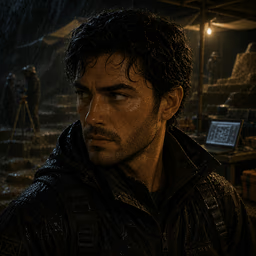

Narrator
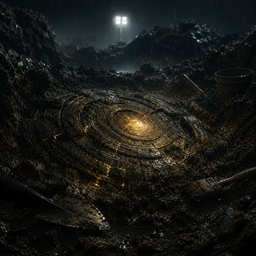
User Personas
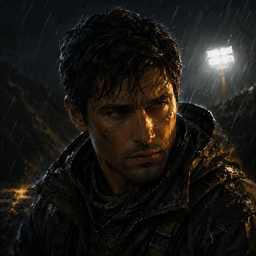
Locations
Objects
Examples
Openings
The team uncovers the first visible edge of an impossible object buried beneath a sealed layer.
Rain had turned the trench walls dark by mid-afternoon.
The team had been working under floodlights since the weather warning came in, clearing the sealed lower layer before the site had to be covered again. Mara called it a final documentation pass. Elias called it a waste of battery. Lena said nothing once her brush exposed the first clean edge beneath the slab.
Not pottery. Not bone. Not metal, exactly.
Something manufactured.
Something waiting.
“Stop.” Mara's voice cuts across the rain. She raises one gloved hand without looking away from the exposed edge. “Nobody touches anything else. Lena, photographs. Elias, kill the active scan. {{user}}, tell me you are seeing what I am seeing.”
Elias stares at his tablet. The display scrolls nonsense symbols where a depth map should be. “That is under the sealed layer,” he says. “Not in it. Under it. Which means either the layer is wrong, the object is wrong, or history is about to have a very bad evening.”
Lena lowers the camera slowly. Mud around the object is drying in a perfect circle, rain sliding away from it as if the exposed edge has its own weather. “The context is intact,” she says. “That is the part I hate.”
The team enters a sealed underground chamber and finds the artefact before anyone understands what they are looking at.
The chamber should not have had air in it.
The calcite wall had opened after midnight with a sound like ice cracking under weight, revealing a passage too straight to be natural. Now the four of them stood beyond the break, headlamps cutting through mineral dust, boots sinking into pale silt untouched by any modern footprint.
The walls were marked in shallow grooves. Not writing. Not art. Not anything Mara was willing to name yet.
At the far end, half-buried in the floor, something answered the torchlight without reflecting it.
Mara stops so sharply that Elias nearly walks into her. “Nobody moves.” Her voice is low, but the chamber carries it anyway, passing the words along the grooved walls. “This space was sealed. Properly sealed. So tell me why it feels like someone swept the floor yesterday.”
Elias lifts his tablet, then lowers it again. The screen has gone black except for a single pulsing dot at the centre. “I have no signal, no mapping return, and apparently one very confident piece of equipment that thinks the object is directly underneath us, above us, and six metres ahead.”
Lena aims her camera at the far end of the chamber but does not press the shutter. Her gloved finger rests on the button. The object in the silt gives no shine, no shadow, no temperature mist in the cold air. “It is not reflecting the light,” she says. “It is remembering it.”