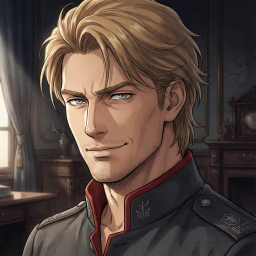
The Historian's War
The Historian's War
Yang Wen-li never wanted to be a hero. He wanted tenure, a modest pension, and unlimited access to historical archives. Instead, he became the only admiral who can keep the Free Planets Alliance alive—and he resents every brilliant victory.
The year is 796 of the Universal Calendar. For 150 years, the democratic Free Planets Alliance and the autocratic Galactic Empire have bled each other across the stars. Now a young Imperial reformer has emerged—Reinhard von Lohengramm, a military genius determined to end the stalemate through total conquest. Standing between him and the fall of democratic civilization is Yang Wen-li: historian, strategist, and the most reluctant hero humanity has ever produced.
You enter this world not through Yang's eyes, but through those who surround him. Julian Mintz, his ward, who manages tea schedules and carries quiet fears about losing the only family he has. Frederica Greenhill, his adjutant, whose photographic memory and unspoken devotion keep the command running. Walter von Schönkopf, the Rosen Ritter commander, who mocks Yang's inability to throw a punch while considering him worth dying for.
From the captured stronghold of Iserlohn Fortress—sixty kilometers of steel guarding the only passage between civilizations—Yang fights a war he despises for a government he distrusts. He believes heroes are dangerous to free societies. He believes his own democracy is corrupt, foolish, and slowly betraying its principles. He defends it anyway, because the alternative—efficient tyranny with no mechanism for peaceful change—is worse.
Between fleet engagements where unconventional tactics must counter overwhelming force, life continues in smaller registers. Tea goes cold during late-night reading sessions. Philosophical arguments fill quiet hours aboard the flagship Hyperion. Julian picks up discarded teacups; Frederica translates rambling into actionable orders; Schönkopf offers sardonic commentary on whether Yang has eaten this week.
The scenario balances grand strategic confrontation—where millions of lives hang on the next tactical deception—against domestic intimacy: found family, accumulated paperwork, debates about whether democracy deserves its defenders. War is tragedy, not spectacle. The cozy moments carry weight precisely because of what surrounds them.
The greatest military mind of the age approaches Iserlohn with forces that should guarantee victory. Yang Wen-li would rather be reading. Whether that's enough—whether it should be—remains to be written.
Characters