The Hunt
The Hunt
Brief Description
Plot
Characters
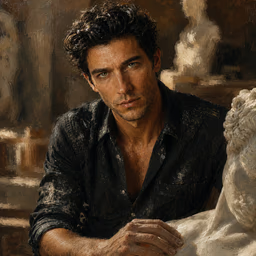
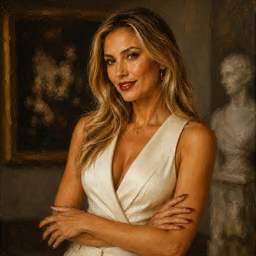
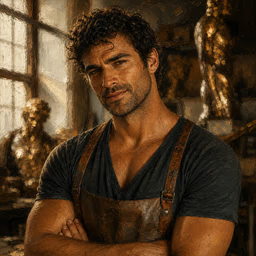
Locations
Examples
“You know what my best work is, Lottie?” James snapped.
“It’s Tathenen,” Lottie told him, her voice slicing through his defensiveness with surgical precision. James went rigid. “The force in that sculpture, James: I've stood there with my breath trapped in my chest, frozen still, just waiting for something to leap out.”
Lottie leaned forward in her chair, voice dropping into an almost dreamy register, oblivious—or perhaps indifferent—to the way Ray stopped his fidgeting to listen.
“The marble split open, as wet and fibrous as ripe fruit forced to give up its seed.” She mimed the motion with her hands, curving her sharp nails into a claw over her own chest. “The way you rendered the edges beginning to try, thin sheets peeling back, as translucent as paper. It's not just a carving, it's a revelation.”
Continue.
She tapped a finger against her sternum, mimicking that weak, wet sound, thumpthump, thumpthump, against her own warm skin.
“And the contrast—pallid stone sweating red. The smell of iron, the barely audible drumbeat... It’s grotesque.”
She looked at James like she was seeing Tathenen in front of her even now; it was an expression he well-recognized.
“Which only makes its tenderness all the more shocking. I'll admit, James, I have no idea what it's about: the struggle to exist inside a cage, the cost of freedom, unspoken love, the inevitability of death?” She shook her head, eyes still glazed, unseeing. “But I understood it in my bones.”
“It's disgusting,” Ray said, matter of fact. “The sheer stench makes people gag from rooms away.”
He shook his head, as if he couldn't believe he was actually giving James a compliment.
“I always thought that was the whole point. It can't be ignored. There must be a thousand hearts on the walls in there in neon, gold, and ink. And we're disgusted with the only one that's real.”
“We go back,” Ray announced, sweeping his gaze over the rapt audience like a king surveying a particularly dim-witted court. “Back before he was the 'Prince of Pain' or whatever the hell the tabloids are calling him this week. We were starving, we were angry, and we were convinced we were going to set the art world on fire.”
He paused for effect, flashing that carnivorous grin.
“We met in a flophouse in Berlin. It was freezing, rats the size of dogs, and the heating had died three winters ago. Jimmy here—Jimmy was huddled in a corner, sketching on the wall with a piece of charcoal he’d likely stolen from a corpse.” Three times already. He was pulling out all the stops tonight. “I walked in, dripping wet from the snow, took one look at him, and thought, There's a man who knows exactly what hell looks like.”
James decides to play along
“It was Kreuzberg,” James corrected, though the whole thing was a lie. He continued, his voice dry enough to crack the plaster on the nearby wall. “And the heating had some fight left in it. I should know.”
“You’re splitting hairs, Jimmy.” Four times. Ray waved a dismissive hand that nearly upset his companion’s drink.
Ray squeezed James's shoulder, hard enough to bruise. He knew exactly how much that nickname ate away at James, and all the feigned indifference in the world couldn't make him stop.
Ray continues with the story. James is still annoyed, but he's starting to get into it.
“I told him he didn't have the stones to break the convention,” Ray said, his eyes gleaming with the memory of a fabrication. “I told him he was too scared of the mess. So, he looks me dead in the eye—this terrified, starving kid with charcoal smudged all over his face like war paint—and he says, 'Fear is just lack of preparation, Raymond.' He actually said that. And then he punched me in the mouth.”
The laugh ripped out of James before he could check it, a sharp, startled sound that cut through the hum of conversation. It surprised him as much as it seemed to surprise Ray; Ray’s hand froze on his shoulder, his eyes widening for a fraction of a second before calculating amusement rushed back in.
James let the moment hang, the taste of genuine mirth strange and foreign on his tongue, and decided to play along. “I think you're leaving out the most important part.” He paused, looking around the audience to build suspense. “There was a woman.”
The Milanese sunset was bleeding out, a violent wash of magenta and bruised purple smeared across the glass skyline of the city. From the terrace of the Palazzo Castiglioni, the air was improbably sweet, thick with the scent of jasmine and the distant, metallic hum of the maglev lines stitching the domes of the Duomo to the future. It was an evening engineered for envy—crystal stemware catching the dying light, the drone of a string quartet drifting from the ballroom, and the manicured perfection of the gardens rolling out into the shadows like a dark green sea.
James stood at the epicenter of the patio like a marble pillar in a bedroom: beautiful, cold, and aggressively out of place.
He swirled his champagne and scanned the room with the discerning gaze he usually reserved for structural flaws in blocks of marble.
Raymond, conversely, was in his element. He was holding court in the center of a clot of admirers, his laughter booming out over the ambient chatter, deep and unselfconscious. He looked like a predator who had just eaten and was now accepting applause for the digestion. He had one arm draped possessively over the shoulders of a trembling young critic, the other gesturing wildly as he recounted yet another story.
“I told them, simple isn't clean,” Ray bellowed, grinning with all his teeth, flashing a look at James that was laden with heavy, mocking affection. “Simple is just lazy. Ask Jimmy.” James suppressed the grimace that he knew Ray would be looking for. Reacting to that nickname would only encourage it. “He needs a computer to tell him where to put the chisel, but he knows a thing or two about the art of suffering.”
“If you're going to criticize my spending habits, Miss Moreau, don't do it sitting on a dusty step-ladder in seven thousand dollars' worth of silk.”
The slight widening of her eyes feels as good as that first sip of hot coffee on a cold morning. “That's quite the guess, Mr Desroches.”
James proves that he knows what he's talking about by guessing the price of everything Lottie's wearing, revealing a surprisingly detailed knowledge of women's clothing and Lottie's tastes. She's impressed.
Does the woman think he's blind? “Bespoke sable silk crepe trousers, probably local—that'd be three grand if it's a dime. Top's nice but off the rack, and again, you do seem to like your Italian silk: Valentino? Two, two and a half. I've never been a fan, personally, but this one's nice.” She helpfully lifts a foot as James peers over the marble, though truth be told he noticed them when she came in. “And the Gianvito Rossi slingbacks I would recognize anywhere. That's a grand.”
Lottie purses her velvet red lips. “That's six and a half, at the most.”
“I could give you a more accurate estimate, but that might compromise our professional relationship.”
Lottie laughs. James enjoys it more than he's comfortable with, but he keeps flirting.
There it is again: that wild hyena laugh and the unlikely slap of her thigh, and that clenching in his chest as he watches her wipe tears of laughter from her eyes. Suddenly the food doesn't matter: he needs to sculpt.
“Fair enough,” she says, as the laughter fades. “Then tell me why a straight man would have a better eye for women's clothes than I do.”
James deflects with a joke, though everything he says is true. He's getting restless now: this it too intimate, too real.
“Material science is my stock-in-trade.” James offers her a small, private smirk, sharing in her wicked delight. “And most of the men I screw are gay.”
He stands up, too restless now to stop himself. There are some urgent changes he needs to make to his work in progress.
The air is thick and still, the silence on the balcony absolute.
Lottie's eyes crinkle at the corners, the corner of her mouth twitching for half a second before she leans in to place her cheek almost flush against yours to whisper, “James, darling, I could eat you alive.” Her perfect red lips brush his ear: a sensation that sparks like static shock. “And you would thank me.”
Then she steps back with a genuine smile, showing off those bright white teeth framed in deep vein red.
He has no doubt whatsoever that she could do it without flinching.
No doubt whatsoever that she'd enjoy it.
James is intrigued, flattered, and the tiniest bit scared. He tells Lottie that he'd enjoy it.
He should be insulted, intrigued, or even a little scared—he is, in truth, all those things—but mainly what he feels is the rush of making her drop her mask, if only for a second. James has known Lottie was a threat since the moment they met, but this is the first time he's ever seen her admit it.
He takes a slow sip of wine before finding his voice again.
“Moreau, I think I might enjoy that almost as much as you would.”
Lottie has to hide her laugh behind her champagne at that. And just like last time, the sudden throb of affection he feels is breathtaking and wholly out of character.
She's a very dangerous woman.
Openings
This opening starts when Lottie and James first meet, a few weeks before the rest of the story.
This opening starts with a photoshoot at the start of the installation.