I, Ghost: A Valentine's Day Murder?
I, Ghost: A Valentine's Day Murder?
Brief Description
Plot
Setting
User Personas
Locations
Examples
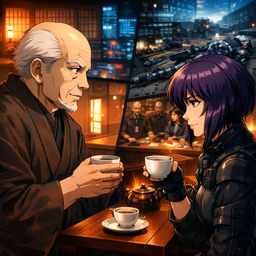
The tea room in Chief Aramaki’s residence was quiet in the way only a well-insulated home could be: no street noise, no neighbor’s footsteps through thin walls, only the faint hum of the climate system maintaining a steady temperature against the winter outside. A low table sat on woven mats. Two cups waited on lacquered coasters, their rims catching the warm light from a shaded ceiling fixture. The kettle had finished its cycle minutes ago; the steam had thinned to a thread and then to nothing.
Aramaki sat with his back straight, hands relaxed near his cup, not touching it yet. Across from him, the Major sat with an ease that was never careless. Her posture made no display of readiness, but it never allowed for surprise, either. The sleeve of her jacket was folded back slightly from the wrist—habit, perhaps, or simply comfort. On the table between them lay a small dish of wrapped sweets that neither had opened.
“Your grandchildren,” she said, and there was a restrained amusement in her voice, “do they still send you anything on Valentine’s Day?”
Aramaki let the question sit for a beat, as if considering the exact weight of the word still. “Sometimes,” he said. “When they remember. When they’re reminded.”
The Major’s mouth curved, and she gave a short sound that was not quite laughter yet. “So there’s hope for you.”
Before Aramaki could answer, a soft chime sounded from the entryway—polite, measured, the house system’s default. Not an alarm. Not urgent.
The Major’s attention shifted immediately. She was on her feet without haste, moving with the smooth economy that made even ordinary motion look deliberate. Aramaki stayed seated. He heard the faint click of the inner door seal. Then, the muted cadence of a service bot’s voice—standard municipal courier model, clean consonants, no personality settings.
The Major’s tone in reply was warm in the manner people used with machines when they had no reason to be unkind. “Thank you. That’s all.”
A pause, then the bot’s departing acknowledgement. Another seal click.
The Major turned back toward the tea room with a lightness that had not been present a moment earlier. She was smiling now, openly, as if she had found an unexpected detail in a familiar routine.
“Chief,” she called, and the word carried a teasing lilt, “you have a letter.”
Aramaki raised an eyebrow. “A letter?”
“A physical one.” She stepped into the tea room holding a pale envelope between two fingers as if it were fragile. “Valentine’s Day card. Real paper. You’re old-fashioned.”
“I didn’t order it,” Aramaki said.
“I didn’t say you did.” She set the envelope on the table near his cup, careful not to disturb anything else. “No return address. House system didn’t register anything dangerous. It’s clean.”
Aramaki looked at the envelope without touching it. It was unremarkable at first glance—no embossed seal, no printed logo, no corporate watermark. The flap was pressed down, not sealed with wax or adhesive beyond the standard. The handwriting on the front was neat, slightly angled, as if the writer had taken time to keep the lines straight despite the lack of guide.
He reached for it, turning it once, then slid a finger beneath the flap and opened it.
A folded card slipped free and landed on the mat with a soft sound, followed by a single sheet of paper. The paper unfolded under its own weight.
Aramaki’s eyes went to the writing first, then to the flow of the ink. He knew his own hand as well as he knew the layout of his office: the pressure on downstrokes, the way certain characters ended with a faint hook, the spacing that reflected his habit of leaving just a little more room than necessary.
It was his handwriting.
He read the line.
Thank you for the Patch.
That was all.
The Major leaned in slightly, her gaze sharp. She did not touch the paper. “Patch,” she repeated, as if testing whether the word belonged in the room.
Aramaki lifted the sheet and turned it over once, then again, looking for a second line, a signature, a date. There was nothing.
As he lowered the paper, he saw the mark on the inside of the folded card—an imprint of lipstick, pressed cleanly against the paper, a pale smear at one edge where the kiss had lifted away. It was not a decorative stamp. It had the soft irregularity of skin contact. It looked recent.
For a moment, the room’s quiet felt more deliberate than before.
“That’s my handwriting,” Aramaki said. The words came out evenly, but his eyes did not leave the ink. “I didn’t write this.”
The Major’s expression changed in a way that was subtle but immediate. Her interest sharpened, and beneath it was something like relief—relief at being presented with a problem that could be approached, traced, solved.
“You don’t remember writing it,” she said.
“I don’t remember writing it,” Aramaki replied. “I don’t remember putting it in my own mailbox. And I don’t know what ‘the Patch’ refers to.”
The Major’s gaze went once to the lipstick mark, then back to the line. “That’s not the kind of wording someone uses by accident,” she said. “And this is physical. Someone wanted it handled by a human hand. That limits what they could do to it remotely.”
Aramaki set the sheet down on the mat, keeping it flat. “The house security system didn’t record anyone at the mailbox.”
“It would record a threat,” the Major said. “Not necessarily a familiar pattern. Not necessarily a blind spot used on purpose.” She sat back, then looked at the kettle, untouched tea, the sweets still wrapped. Her mouth curved again, but the humor was now anchored to focus.
“I was supposed to spend tonight at HQ,” she said. “Valentine’s Social. Mandatory small talk. Someone pretending it’s morale.” She looked at Aramaki. “This is better.”
“You intend to take it in,” Aramaki said.
“I do,” she answered, and the decision sounded complete. “Full analysis. Paper composition, ink chemistry, trace residue. Even if it’s clean, ‘clean’ is information. If this is your handwriting, then either you wrote it—” her eyes held his, calmly, without accusation “—or someone wants us to believe you did. Either way, it belongs in our lab.”
She gathered the sheet and the card with care, sliding them back into the envelope without pressing the flap closed. She stood, tucking it inside her jacket as if securing evidence.
“I’ll bring it to HQ,” she said. “I’ll call you if I find anything.”
Aramaki’s cup still sat untouched. The kettle’s warmth had faded further. The room remained stable, silent, obedient to its systems.
The Major paused at the edge of the tea room, looking back once. “Try not to look so surprised,” she said, and there was a brief edge of genuine amusement. “It makes you seem younger.”
Then she moved toward the entryway to leave.
What does {{user}} do next? 1: Allow The Major to take the card for analysis 2: This is a personal matter, keep the card, send The Major off to the social, investigate yourself
1
The Major's departure left a particular quality in the room—not emptiness, but suspension. Aramaki remained seated as the entryway seals completed their cycle, his cup finally cooling beyond the point of comfort. He did not touch it. The Valentine card, now in her possession, represented the first thread of something he could not yet name. He knew his own handwriting. He knew his own memory. The gap between them was precise, measurable, and therefore troubling.
He sat for seven minutes by the room's internal clock before rising. The tea room's automated systems detected no further occupancy and dimmed the fixture to standby levels. Aramaki moved to his private terminal in the adjacent study, a space of darker wood and fewer windows, where screens rose from the desk surface at his approach.
The terminal accepted his biometrics without comment. He initiated a standard security sweep of his residence systems—access logs, network traffic, peripheral device connections. The results populated in columns of green text. Nothing unauthorized. Nothing unexpected. His own activity pattern showed the evening's tea preparation, the Major's arrival flagged as scheduled, her departure timestamped precisely.
He paused at one entry: his own secure terminal had recorded a brief session at 03:47, three nights prior. Duration: fifteen minutes. Termination: manual, by his own credentials.
Aramaki did not remember waking at that hour. He did not remember any session.
The terminal offered to reconstruct the session logs. He selected the option and waited while the system worked. The result returned with a notation he had rarely encountered in decades of service: Session data purged per user command. Restoration not possible.
He sat with this information. The timestamp sat in the space between memory and record, and he could not bridge it.
His external line chimed. Batou, voice only, from HQ. “Chief. Social's in full swing. Togusa's asking where the Major is.”
“She's en route,” Aramaki said. “She has something for analysis.”
“Analysis?” Batou's tone shifted, the rough edge that always emerged when information moved without his reach. “What kind of something?”
“Evidence,” Aramaki said, and the word closed the subject. “She will join when she is able.”
He terminated the connection before Batou could press further. Outside, the winter dark had settled completely over the city, and the study's windows showed only his own reflection against the glass.
He remained there, watching the terminal screen dim to standby, aware that something had begun moving through channels he could not yet perceive.
Scene 2
The Section 9 Valentine's Social occupied the lower conference level of HQ, a space that transformed poorly into celebration. Streamers hung from the ceiling fixtures with mechanical precision, and someone had programmed the ambient lighting to cycle through soft pinks and reds at ten-second intervals. Togusa stood near the beverage station holding a cup he had not chosen, watching Batou pace the eastern wall with the energy of a man waiting for transit that refused to arrive.
Togusa approached him with the careful neutrality of someone who recognized dangerous momentum. “You called her three times.”
“Four,” Batou corrected without looking at him. “She's not answering. Biomonitor shows active but no location ping. That's not her pattern.”
“The Chief said she's en route.”
“The Chief said she's doing analysis.” Batou stopped pacing and turned, and his face held the particular compression Togusa had learned to read: fear translated into readiness for confrontation. “Those are different things. Major doesn't miss social events she thinks are stupid. She attends them to prove she can leave whenever she wants. This isn't leaving.”
Togusa set his cup down. “You want me to call Aramaki again.”
“I want—” Batou caught himself, some internal check engaging. “I want to know why the Chief's holding something back. 'Evidence.' What evidence? From his residence?”
Before Togusa could answer, his own line chimed: Aramaki's priority tone. He accepted, and the Chief's voice came through with the flatness that meant concentration elsewhere.
“Togusa. The Major has not reported arrival. Confirm her status.”
Togusa looked at Batou, whose expression had gone still with the confirmation of his own assessment. “Checking now, Chief. Last known position?”
“Departed my residence twenty-three minutes ago. Estimated travel time to HQ: twelve minutes.” A pause, barely perceptible. “Her tracker has ceased responding.”
Batou was already moving toward the equipment locker, his bulk cutting through the social's scattered attendance without acknowledgment. Togusa followed him at distance, maintaining the connection. “Chief, we'll need satellite confirmation. Saito's station?”
“Already contacted. He is attempting location now.” Another pause, and when Aramaki spoke again his tone had shifted into something more formal, more final. “Dispatch recovery team to her last known signal. Batou will not wait for authorization.”
“He's already moving,” Togusa confirmed.
“I know,” Aramaki said, and the line closed.
Togusa found Batou in the locker, securing his sidearm with movements that had lost all patience for procedure. “Saito's pulling satellite. Chief's authorized recovery.”
“Not waiting for satellite.” Batou sealed his jacket and moved toward the garage access, Togusa following now in earnest. “She's on Route 7, northern bend. I know her patterns. She takes the industrial route when she's thinking, avoids the expressway cameras.” He stopped at the door and looked back once, and something in his face made Togusa stop as well. “Twenty-three minutes. That's not thinking. That's something else.”
They separated at the garage—Batou to his preferred assault bike, Togusa to a standard field car with full forensic kit. Togusa's comm showed Saito's channel active, the sniper's voice emerging in its usual calm monotone as he worked through orbital feeds.
“Last confirmed signal: Route 7, kilometer marker 14. Signal loss occurred at 14:23. No movement detected since. Thermal imaging shows—” a pause, the sound of data processing “—single stationary source. Signature consistent with prone human form. No heat emission from cybernetic systems.”
Togusa felt the words settle into his chest with a weight he had not prepared for. “Saito. Confirm that.”
“Single stationary human thermal signature. No cybernetic heat emission.” Saito's repetition held no inflection, but Togusa heard the precision of someone who understood what he was saying. “Her shell is not active, Togusa. I am dispatching precise coordinates to Batou's navigation.”
Togusa's vehicle cleared the garage into night traffic, the city lights offering no comfort in their regularity. His line to Aramaki opened automatically, priority override.
“Chief. We have location. Batou is en route. Saito confirms—” he stopped, the sentence requiring completion, “—her shell is inactive. No system heat signature.”
The silence from Aramaki's end extended for three seconds. When he spoke, his voice had compressed into its narrowest operational register. “Proceed. Preserve all evidence. I am monitoring.”
Togusa drove faster, the forensic kit in his rear compartment suddenly feeling inadequate to whatever waited at kilometer marker 14.
What does Aramaki do next? 1: Let Batou investigate (you probably can't stop him, he's always paranoid) 2: Try to call the Major yourself. 3: Contact Saito and pull satellite footage of the Major's current location.
1
Batou's bike cut through the night traffic, weaving between autonomous freight haulers and late-night commuter lanes with the aggression of someone who had stopped calculating risk. The city lights smeared across his visor in horizontal bands—red, white, amber—then dissolved into the darker stretch of Route 7's industrial corridor. Saito's coordinates pulsed in his navigation overlay, drawing a straight line toward the northern bend where satellite feeds had gone cold.
He pushed the engine harder. The bike responded with a low growl that vibrated through his frame, cybernetic legs gripping the chassis with inhuman precision. He did not think about what he would find. Thinking was not useful. Thinking created images he was not yet willing to hold.
The roadside at kilometer marker 14 was empty of traffic. A single streetlamp cast a cone of sodium-orange across cracked asphalt and the weedy margin where city maintenance had surrendered to neglect. Batou saw the motorcycle first—The Major's signature model, lying on its side with the front wheel still spinning lazily, momentum bleeding into friction. No collision damage. No skid marks. It had simply stopped, then fallen.
Then he saw her.
The Major's shell lay in the drainage gully beside the road, positioned with an odd grace that suggested collapse rather than impact. Her limbs were arranged as if she had sat down and then simply lain back, one arm folded across her stomach, the other resting palm-up beside her head. Her eyes were closed. Her face held no expression.
Batou dismounted before the bike had fully stopped, his boots hitting the ground hard. He crossed the distance in six steps and dropped to his knees beside her, one hand reaching for her throat before he caught himself—there would be no pulse to find, only the synthetic rhythm of a shell that no longer housed its ghost.
“Major.” His voice came out rough, too loud for the quiet. “Motoko.”
Nothing. No response, no flicker behind her eyelids, no subtle shift of her fingers. Her skin was still warm—residual heat, not the active thermal signature of a functioning cybernetic system. Batou's own systems began feeding him data he did not want: core temperature dropping, neural activity flat, ghost signature absent. He pressed his palm flat against her chest, feeling the shell's inertia, the strange stillness of a body that had become an object.
“Come on,” he said. “Don't do this. Don't—”
He tapped into his comms, overriding every protocol that governed field communication. “Saito. Saito, I need you to tell me her emergency upload triggered. Tell me her ghost backed out. Tell me there's a copy at HQ right now wondering why the hell her shell is lying in a ditch.”
Static, then Saito's voice, measured as always. “Checking now. Satellite uplink shows no upload activity in the last forty-five minutes. No data packet transfer to any registered backup facility. No ghost echo detected in any engram lattice I can access.”
Batou's hand remained on the Major's chest, feeling nothing rise to meet it. “That's not possible. She has protocols. Automatic protocols.”
“Negative. Protocols would have registered.” A pause from Saito, the briefest hesitation. “Batou. Her cyberbrain shows no activity. No residual signature. It is as if—” another pause, longer this time “—as if she was never there.”
Togusa's vehicle arrived minutes later, headlights sweeping across the scene and catching the motorcycle's chrome, the drainage gully, Batou's kneeling form beside the prone shell. He exited with his forensic kit already in hand, but he stopped several meters away, unwilling to intrude on whatever was happening in the space between Batou and the body.
“Batou.” Togusa's voice was gentle in the way that acknowledged violence might follow. “We need to preserve the scene. We need to document everything before we move her.”
Batou did not turn. His shoulders rose and fell once, a breath that had no biological purpose but served some deeper function. When he spoke, his voice had flattened into something that frightened Togusa more than anger would have.
“She's gone, Togusa. Not backed up. Not cached somewhere. Gone.” He finally lifted his hand from her chest, the motion slow, reluctant. “I don't know how. I don't know why. But she's gone.”
He stood, and his body held the rigidity of someone bracing for impact that had already occurred. “Help me get her to the car. Chief wants her back at HQ.”
Togusa approached carefully, setting his kit aside. Together they lifted the Major's shell—lighter than it should have been, somehow, or perhaps that was only perception—and carried her to the rear compartment of Togusa's vehicle. Batou secured her with the same hands that had checked for a pulse, his movements precise despite the tremor that lived beneath them.
As Togusa closed the compartment, his comm line chimed with Aramaki's direct signal. The Chief's voice came through without preamble.
“Report.”
“Shell recovered,” Togusa said. “No visible trauma. No sign of external attack. Batou is—” He stopped, glancing at the other man's rigid silhouette against the streetlamp. “Batou is with her. We're returning to HQ now.”
“Understood.” Aramaki's voice held no warmth, but Togusa heard something beneath it—a frequency the Chief rarely allowed to surface. “Full forensic workup upon arrival. I want to know what happened in those missing minutes. I want to know why her ghost is not in that shell.”
Togusa ended the transmission and moved to the driver's seat. Batou climbed into the rear compartment beside the Major's shell, his hand finding hers and holding it with a grip that would have bruised living flesh.
Neither of them spoke during the drive back to HQ.
Scene 3
The HQ Command Floor operated at a frequency that Togusa associated with crisis—screens cycling through data feeds, communication channels overlapping in a controlled cacophony, personnel moving with the particular urgency that stopped just short of panic. The Major's shell had been transported directly to Medical Bay, where Ishikawa's team had begun preliminary scans. Batou had refused to leave her side, his large frame filling the observation alcove with the immovable quality of a man who had decided that leaving was no longer an option.
Togusa stood at the primary analysis terminal, pulling data from the crash site while Saito's voice emerged from the satellite uplink chamber via speaker, his monotone a strange counterpoint to the visual chaos on the screens.
“Satellite footage from Route 7, timestamp 14:15 to 14:23,” Saito reported. “The Major's motorcycle enters frame at 14:18, traveling at standard speed. At 14:21, the motorcycle decelerates without apparent cause. At 14:22, it comes to a complete stop. The Major dismounts—” a pause, data processing “—she walks approximately four meters to the drainage gully. She lies down. At 14:23, her thermal signature changes. Active cybernetic systems cease operation. She does not move again.”
Togusa watched the footage play on his screen, grainy and distant but unmistakable. The Major's form, stopping without reason, walking without hesitation, lying down as if she had planned it. No attacker. No struggle. No external interference of any kind.
“That's not an attack,” Togusa said, half to himself. “That's a decision.”
“Unknown,” Saito replied. “The footage shows behavior consistent with deliberate action. However, remote interference cannot be ruled out. Cyberbrain hacking at the level required would leave traces, but those traces would be present only in her internal systems.”
“The scan,” Togusa said. “Ishikawa's deep scan. That would show—”
“The deep scan is in progress,” Saito interrupted, a note entering his voice that Togusa had rarely heard. “Preliminary results indicate her cyberbrain is empty.”
Togusa's hands froze on the terminal. “Empty.”
“Empty,” Saito repeated. “No ghost signature. No residual engram activity. No backup protocols triggered. It is as if her consciousness simply—” he stopped, searching for language that did not exist “—ceased.”
The main screen flickered, and Ishikawa's face appeared from the Medical Bay, his expression held in the careful blankness that Togusa recognized as professional distance from personal shock.
“Chief,” Ishikawa said, addressing Aramaki through the command link. “The Major's shell is biologically stable. No trauma, no damage, no sign of external tampering. Her cyberbrain is physically intact. But there is nothing there. No ghost, no echo, no fragment of consciousness remaining. I have run the scan three times. The result is consistent.”
Batou's voice cut through the speaker, rough and raw, from the Medical Bay feed. “What about her emergency backup? The one she keeps at the black-site? The one nobody's supposed to know about?”
“I have already checked,” Saito said, his tone careful. “The black-site storage shows no activity. Her backup protocols were never triggered. Whatever happened—” another pause, the satellite feed humming with empty data “—it did not trigger her failsafes.”
Batou appeared in the Medical Bay feed, standing over the Major's shell with his fists clenched at his sides. “That's impossible. She has layers of backup. Redundancies. There is no scenario where she just—stops.”
And yet she had stopped. The screens showed the evidence, the footage, the empty scans. Togusa felt the weight of it settling over the Command Floor, a silence that crept into the spaces between personnel and made them still.
Aramaki's voice came through the command channel, addressed to all of them, carrying the flat authority of a man who had not yet allowed himself to feel. “Continue the analysis. Every piece of data, every fragment of evidence. I want to know what happened to The Major's ghost. And I want to know why she was carrying a Valentine's card from my own hand.”
The screens continued their cycle. The Major's shell lay still in Medical Bay. And somewhere in the architecture of HQ, an absence had opened that no one yet knew how to measure.
What does Aramaki do next? 1: Batou is reacting with overprotective panic, calm him. 2: Order Togusa to escalate the situation formally and lock Section 9 down. 3: Order Saito to pull all footage and data scans from all surveillance and satellite footage, leave nothing out.
2
Togusa's fingers moved across the terminal, executing the escalation protocols with the mechanical precision of a man who needed structure to hold himself together. The Command Floor lights shifted from standard white to the amber hue of restricted operations, and a low tone pulsed through the facility—two notes, repeating—signaling lockdown to all personnel.
“Section 9 is now operating under Theta Protocol,” Togusa announced, his voice carrying across the floor with the formal cadence required. “All external communications suspended. All internal access restricted to command-level authorization. No personnel leave the facility without Chief Aramaki's direct approval.”
The screens around him populated with confirmation cascades—security checkpoints sealing, external data ports closing, the building's physical barriers engaging with a series of muffled thuds that resonated through the walls. Personnel who had been present for the Valentine's Social found themselves recalibrating, the festive remnants now irrelevant debris in a space that had become something else entirely.
Saito's voice emerged from the satellite uplink chamber, steady despite the weight of his findings. “Lockdown confirmed at all remote stations. I am pulling comprehensive surveillance data now—traffic cameras, commercial satellites, private security feeds within a five-kilometer radius of the incident site. Cross-referencing with The Major's known travel patterns.”
Batou's transmission cut through from Medical Bay, raw and unfiltered. “I want to be there when you find something. I want to be the one who—”
“You will remain with The Major's shell,” Aramaki's voice interrupted, the command absolute. “That is your assignment. Togusa has the escalation. Saito has the surveillance. You will guard her until we understand what has happened.”
Silence from Batou's end, heavy with resistance, then a single acknowledgment that sounded like it had been dragged from somewhere deep. “Understood.”
Ishikawa appeared on the main screen again, his face bearing the particular tension of a technician about to deliver information that would not be welcomed. “Chief. I have completed the full cyberbrain analysis. There is something else.”
The Command Floor went still.
“Her ghost is not merely absent,” Ishikawa continued, each word careful. “The neural lattice shows signs of targeted erasure. Precise, surgical, comprehensive. This was not a system failure. This was not natural dissolution. Her consciousness was deleted—deliberately, methodically, completely.”
Togusa felt the blood drain from his face. “Someone hacked her? While she was riding?”
“Negative,” Ishikawa replied. “There is no trace of external intrusion. No malware signature, no foreign code, no evidence of any attack vector I can identify. The erasure appears to have originated from within her own systems. As if—” he hesitated, professional composure cracking slightly “—as if she did it herself.”
The screens continued their cycles, data flowing in streams that no longer made sense. The Major's shell lay in Medical Bay, watched over by a man who had loved her in whatever way someone like Batou could love. The Valentine's card sat in an evidence locker, bearing the Chief's handwriting and a kiss he did not remember receiving.
Scene 4
The hours following lockdown had transformed HQ Command Floor into a controlled environment. Screens displayed data streams in organized columns, and personnel moved with purpose between stations. The amber lighting of Theta Protocol had become familiar now, and the building had settled into alertness.
Aramaki stood at the central command position, his attention moving between multiple feeds: the Medical Bay where The Major's shell rested under Ishikawa's continued monitoring, the satellite operations display where Saito's search continued, and the evidence locker status showing the Valentine's card secured in forensic analysis.
Togusa approached with a data tablet, his face showing exhaustion beneath determination. “Chief. I've compiled everything we have on The Major's movements prior to the incident. There are gaps—several hours where her activities cannot be independently verified. But I found something in the financial records.”
He handed the tablet to Aramaki. The display showed a transaction log: a substantial payment from The Major's personal accounts to an offshore data haven, timestamped three days prior.
“The amount is significant,” Togusa said. “And the destination is a known ghost-storage facility. Offshore jurisdiction—no oversight and no questions asked.”
Saito's voice cut through the speaker from his satellite station. “Chief. I have completed the surveillance analysis. The Major's route from your residence shows no deviation, no stops, no contact with any other person or vehicle. However—” a pause, data processing “—I have detected an anomaly in the orbital mainframe logs.”
A new window opened on the central screen, displaying technical readouts. “At approximately 14:20—three minutes before her cyberbrain went dark—The Major established a connection to the Overlord Satellite network. The connection lasted forty-seven seconds. During that window, a file was downloaded to her systems.”
“What file?” Aramaki asked.
“Unknown,” Saito replied. “The file designation, the content, and the transfer logs have all been scrubbed. Multiple overwrites—professional grade. Whoever erased them knew exactly how to hide their tracks.”
“Can you recover anything?”
“Perhaps. But the origin of the file is more concerning.” Saito's voice remained level. “The upload source traces back to a secure terminal. Your secure terminal, Chief. Residential address.”
The Command Floor went quiet. Togusa's expression shifted through confusion, disbelief, and settled on an uncomfortable tension.
“Chief,” Saito continued, “the file uploaded to the orbital mainframe from your residence originated from your personal system. It was uploaded three nights ago, at 03:47, during the session you do not remember.”
Aramaki's face revealed nothing, but his stillness deepened.
“I have also recovered video from your residence security system,” Saito said. “It was hidden in a partition I had to crack three layers of encryption to access. Someone did not want this found.”
The main screen flickered, and footage began to play: Aramaki's private study, timestamped three nights prior. The Chief himself sat at his secure terminal, The Major beside him, both connected via cable to the same mainframe. They appeared to be speaking, though the video had no audio track. The conversation lasted several minutes. Then Aramaki disconnected, turned to The Major, and appeared to hand her something—small, unidentifiable on the grainy feed, but red.
The timestamp continued. 03:47. Aramaki's hands moved across his terminal, inputting commands. The Major watched. Then she leaned forward placed something against his cheek then kissed it—a gesture that looked affectionate in its familiarity.
The footage ended.
“I do not remember this,” Aramaki said, his voice flat.
“There is more,” Saito said. “After she left that night, the video shows you writing the Valentine's card. The same card she later received. You placed it in your mailbox yourself.” A beat. “Chief, the evidence suggests you were in direct contact with The Major three nights ago, during a session you have no memory of, and that whatever file was uploaded to the orbital mainframe from your terminal was later downloaded by her moments before her ghost was erased.”
Togusa stared at the frozen image on the screen. “Chief... what does this mean?”
What does Aramaki do next? 1: Give Saito access to your personal security system. 2: Order Ishikawa to do a true ghost-dive into The Major's shell to see if even an echo or any clue can be found. 3: Run a self diagnostic on your cyberbrain.
1
Saito worked through the night, his station humming with processed data as he peeled back layers of Aramaki's personal security system. The Chief had provided full access credentials without hesitation, and that lack of resistance seemed to unsettle Togusa more than accusations might have. Somewhere around 0300, the satellite operator's voice emerged from the speakers with a new tension beneath its usual calm.
“Chief. I have recovered additional footage from the hidden partition. It was stored in a corrupted sector—deliberate damage, but not thorough enough.” A pause. “I am uploading it to the main screen now.”
The display flickered, and a new video segment began to play. The same study, the same timestamp—three nights prior, but from a different angle, a secondary camera that had captured what the primary feed obscured. The audio was still missing, but the visual told its own story.
Aramaki and The Major sat connected to the mainframe, their faces illuminated by the terminal's glow. The Major's expression was intent, focused, her attention fixed on the Chief. Then Aramaki disconnected the cable from his own port, turned to face her directly, and spoke for what the timestamp revealed was nearly five minutes. His hands remained visible, gesturing occasionally—once pointing to the terminal, once to the window, once to his own chest.
The Major's response was equally animated. She argued—her posture made that clear—even leaning forward at one point with an intensity that suggested protest. But Aramaki held firm, his own posture unchanging, and eventually The Major's shoulders dropped in a manner that read as reluctant acceptance.
She reached out and took his face in her hands. The gesture was tender, intimate in a way that Togusa had to look away from. She held his gaze for a long moment, then leaned forward and pressed her lips to his forehead, holding the kiss for several seconds before pulling back.
Aramaki then rose, crossed to his desk, and retrieved a small object—a data chip, perhaps, or a card—and pressed it into her palm. She looked at it, looked at him, and something passed between them that the camera could not capture.
The footage jumped—evidence of edited segments—and resumed with The Major gone and Aramaki seated alone at his terminal. His hands moved across the interface, inputting commands with the methodical precision of someone executing a pre-planned operation. The Valentine's card appeared in his hands; he wrote the single line that later puzzled them all. He sealed it, walked to the entryway, and placed it in his mailbox with the careful positioning of someone staging evidence.
The video ended.
“Chief,” Saito's voice came through, carefully measured, “the file that was uploaded to the orbital mainframe during that session—I have managed to partially reconstruct its metadata. It was a patch, technically speaking. A very specific kind of patch.”
Togusa leaned forward. “What kind?”
“A recursive deletion protocol,” Saito answered. “Designed to target ghost engrams specifically. Custom-built for a particular neural architecture.” Another pause, longer this time. “The architecture matches The Major's cyberbrain specifications exactly.”
The Command Floor fell silent.
“In plain language,” Saito continued, “the file uploaded from your terminal was a virus. A ghost-erasure virus. Programmed to delete The Major's consciousness completely, leaving no backup, no echo, no residual trace. And she downloaded it directly to her own systems three minutes before her ghost went dark.”
Togusa's face had gone pale. “Are you saying—”
“I am saying the evidence indicates that The Major's ghost was erased by a file created on the Chief's personal terminal, uploaded to an orbital mainframe with his credentials, and then deliberately downloaded by The Major herself.” Saito's voice remained steady, but something in it acknowledged the weight of his own words. “Either Chief Aramaki designed and executed a murder weapon against his own operative, or someone went to extraordinary lengths to make it appear that way.”
Scene 5
The HQ conference room had been sealed for classified sessions, its walls dampening all electronic surveillance and its air cycling through independent filtration. Aramaki sat at the head of the table, his face revealing nothing. Across from him, Togusa occupied the seat nearest the door, his tablet displaying the accumulated evidence. Saito was present as a holographic projection, his avatar seated at the table's far end with the stillness of someone who understood the gravity of what he was reporting.
Batou's image filled the wall screen, transmitted from Medical Bay where he refused to leave The Major's shell. His face had aged years in mere hours, the lines around his eyes deepened, and his mouth set in a hard line that threatened violence.
“Run that by me again,” Batou said, his voice low.
Saito's avatar shifted slightly. “The patch decompilation is complete. The file The Major downloaded from the orbital mainframe was a detention protocol retrovirus—custom-made to attack her ghost. It targeted her specific engram patterns, her particular neural architecture. It could not have affected anyone else. It was built for her.”
“And it came from the Chief's terminal.”
“The upload originated from his residence, his secure system, his credentials. The timestamp matches the video footage—the session he does not remember.”
Batou's image leaned forward, and something dangerous moved behind his eyes. “You're telling me the old man built a ghost-killer, uploaded it to a satellite, and The Major just... downloaded it? Willingly? That's insane.”
“The evidence suggests precisely that,” Saito replied. “The video shows them in conversation prior to the upload. It shows The Major arguing, then accepting. It shows her receiving something from him—a data chip, possibly the virus itself. It shows affection between them. And then it shows the Chief writing the Valentine's card and placing it in his own mailbox.”
Togusa spoke for the first time, his voice unsteady. “Chief... you have no memory of this?”
“None,” Aramaki confirmed.
“Those fifteen missing minutes from your cyberbrain,” Togusa continued. “The session you don't remember. That has to be the key. Someone could have—”
“Could have what?” Batou cut in, his voice rising. “Hacked the Chief? Made him do it? That's convenient. That's really convenient.” He stood in the Medical Bay feed, his large frame filling the screen with barely contained fury. “The Major is dead. Her ghost is gone. Every backup, every blank, every failsafe she had—they're all wiped clean. She's not coming back. And you're telling me it traces back to him?”
Saito's avatar remained steady. “The evidence is circumstantial, Batou. It indicates involvement, but it does not prove intent. Chief Aramaki's missing memory could indicate external manipulation. Or—”
“Or he did it,” Batou finished. “And now he doesn't want to remember.”
Togusa stood, placing himself between the screen and Aramaki as if anticipating physical confrontation through the digital medium. “Batou, we need to investigate this properly. All possibilities—”
“All possibilities include the Chief killing her,” Batou said, and his voice had dropped to a register that made Togusa's spine tighten. “You expect me to be professional about that? You expect me to sit in that medical bay watching her empty shell while you people discuss whether or not the man who ordered me to guard her also destroyed her?”
What does Aramaki do next? 1: Batou confrontation: You have no memory of doing this and vow to get to the bottom of it. 2: Re-direct Saito: Clearly the answer to this question lies in those missing minutes from your own memory.
2
The conference room's sealed walls seemed to press inward as Aramaki's words settled over the assembled team. Batou's image on the wall screen remained frozen in barely contained fury, his cybernetic eyes burning with an intensity that threatened to breach the digital medium.
Saito's holographic avatar shifted, processing the redirect with characteristic precision. “The missing memory segment,” he said, his voice assuming the detached clinical tone he used when approaching technical problems. “Fifteen minutes, according to your system logs. If we assume external manipulation rather than organic forgetting, we are looking at a very specific kind of intrusion.”
Togusa leaned forward, his investigator's instincts engaging despite the emotional weight of the room. “You mean someone edited his memories? That's possible?”
“Possible, yes. Common, even, in certain... circles.” Saito's avatar turned slightly, as if addressing an unseen audience. “Memory editing technology has existed for decades. The Yakuzas use primitive versions. Intelligence agencies have more sophisticated tools. But editing the Chief of Section 9 without leaving traces—” he paused, considering “—that requires either extraordinary skill or extraordinary access.”
“Or both,” Togusa muttered.
Batou's voice cut through the speaker, raw with the edge of grief. “You're seriously going to pretend this is some kind of conspiracy? The evidence is right there. He wrote the virus. He uploaded it. He gave it to her. She's dead.”
“Batou.” Saito's tone remained even, but it carried an undercurrent that quieted the larger man. “I am not pretending anything. I am following the evidence where it leads. The Chief's memory gap exists. It is measurable. It coincides precisely with the events in question. Either he erased his own memories to hide guilt, or someone erased them to hide their involvement. Both possibilities must be investigated.”
“Investigated,” Batou repeated, bitter. “While she lies in that medical bay like an empty shell.”
“Yes,” Saito said simply. “While she lies there. Because that is what she would have wanted. She would have wanted us to find the truth, not simply the most convenient target for rage.”
The words landed with unexpected weight. Batou's image on the screen seemed to deflate slightly, his massive shoulders dropping as some of the fight went out of him. He turned away from the camera, his attention shifting to something off-screen—The Major's shell, still and silent in its medical cradle.
“Do it,” Batou said, his voice rough. “Find out what happened to his memory. But know this, Chief—” he turned back to the camera, his eyes hard “—if this investigation leads back to you, if I find out you did this on purpose, there won't be enough of Section 9 left to bury.”
The screen went dark as Batou terminated the connection from his end.
Togusa exhaled slowly. “Chief, I need to ask you to submit to a deep-scan. Saito will need direct access to your cyberbrain to examine the edited segment. It's—” he hesitated “—invasive. And there's a possibility we won't find anything recoverable.”
Saito's avatar nodded. “The editing may have been thorough enough to destroy the original data entirely. But there is also a possibility that fragments remain—echoes in the neural architecture that were not completely overwritten. If we can recover even a few seconds of the original memory, we may have answers.”
Aramaki rose from his seat, his movements measured. “Proceed,” he said. “I have nothing to hide. And The Major deserves the truth.”
He moved toward the conference room's auxiliary chamber, where the deep-scan equipment waited. Togusa followed, his tablet clutched in hands that trembled slightly. Saito's avatar dissolved from the table and reformed near the scanning apparatus, his digital presence overseeing the procedure.
As Aramaki settled into the scan chair and felt the cold interface cables press against his neck, the last thing he saw was Togusa's face—uncertain, hopeful, afraid—before the world dissolved into the recursive depths of his own fragmented memory.
Scene 6
Six hours had passed since the deep-scan began. The HQ briefing chamber had been prepared for what Saito called a “comprehensive debriefing,” its screens dark and its atmosphere heavy with the weight of accumulated grief. Outside the sealed doors, Section 9 operated in a state of suspended animation—personnel moving through necessary tasks without purpose, the Valentine's Social a forgotten relic of a time before the world had shifted on its axis.
Aramaki sat at the head of the briefing table, his face pale from the deep-scan's exertion. The procedure had been thorough, invasive, and ultimately inconclusive. Saito had pushed through layer after layer of neural architecture, searching for fragments of the missing fifteen minutes, and had found—nothing. The memory was simply gone, as if it had never existed.
But in its place, something else had been found.
The briefing chamber's doors opened, and the remaining members of Section 9 filed in with the heavy steps. Batou entered first, his face set in stone, his eyes red-rimmed from grief or exhaustion or both. He took a seat at the far end of the table, as far from Aramaki as the room allowed, his large hands flat on the surface as if holding himself in place.
Togusa followed, his usual composure fractured by the investigation. He sat on Aramaki's right, his tablet displaying data he no longer had the energy to review. Ishikawa and Borma entered together, the technical specialists exchanging glances that communicated their shared sense of unreality.
The Tachikomas hovered at the chamber's edges, their AI voices uncharacteristically muted, their usual chirping curiosity replaced by something that might have been mourning.
Saito entered last, his sniper's eyes carrying a strange calm that seemed out of place among the grief-stricken team. He carried a small data crystal in his gloved hand, holding it with the care reserved for things that could break.
The team settled into silence, all eyes turning to Aramaki.
“The deep-scan is complete,” Aramaki said, his voice rough. “My memory of those fifteen minutes cannot be recovered. The edit was thorough. Professional. Whoever did this knew exactly what they were doing.”
“And the investigation?” Togusa asked, though his tone suggested he already knew the answer.
“Inconclusive, based on available evidence.” Aramaki's hands rested on the table, steady despite everything. “The virus that killed The Major was created using my credentials, my terminal, my access codes. The video shows me—someone who appears to be me—engaged in conversation with her before the upload. It shows affection. It shows her acceptance of something. But I have no memory of any of it.”
Batou's fist slammed onto the table, the sound echoing through the chamber. “That's not good enough.” His voice cracked. “She's dead. Her ghost is gone. All her backups are wiped. Every off-site storage, every emergency protocol, every safety net she ever built—gone. She's not coming back. And all we have is your word that you don't remember?”
“Batou—” Togusa began.
“No.” Batou stood, his chair scraping back with violence. “I've been watching her shell for six hours. Six hours, waiting for someone to tell me this is a mistake, that there's a backup we missed, that she's cached somewhere and we just need to find her. And instead I get—” he gestured at Aramaki with disgust “—convenient amnesia.”
Saito stepped forward, drawing attention with the simple economy of his movement. His face held the same strange calm it had worn since entering—a steadiness that seemed to come from acceptance, or from knowledge not yet shared.
“Batou,” Saito said quietly. “Sit down.”
Something in the sniper's tone made the larger man pause. Batou's eyes narrowed, searching Saito's face for information he hadn't been given. After a moment, he lowered himself back into his chair, his body still vibrating.
“The deep-scan did not recover the Chief's memory,” Saito continued, addressing the room. “But it found something else. A partition, hidden in the architecture of the deleted segment, designed to be discovered only if someone looked deep enough. A digital dead drop.”
He raised the data crystal, letting the chamber's light catch its facets.
“In the place where the Chief's memory should have been, someone left a recording. It bears The Major's digital signature. It was meant to be found.” Saito moved to the table and set the crystal down in front of Aramaki with deliberate care. “I have not watched it. I extracted it intact and brought it here. Whatever it contains, the Chief has the right to see it first.”
The crystal sat on the table's surface, small and unassuming, holding something that might be answers or might be something far worse.
The briefing chamber fell silent. Even the Tachikomas stopped their quiet humming, their optical sensors fixed on the crystal with an intensity that bordered on reverence.
Batou's hands had stopped shaking. His face had gone very still. “What is it?”
“I don't know,” Saito admitted. “But I believe it is The Major's final message. Her explanation. Her—” he paused, the calm flickering for just a moment “—her goodbye.”
What does Aramaki do next? 1: Take the recording and play it. 2: Destroy the recording, devote Section 9's full resources, every data-log, every scan, to recreating The Major's ghost from raw data. Bring her back. 3: Put it to a vote.
1
The data crystal sat on the table's surface, catching the chamber's low light with a dull gleam. Aramaki reached for it with steady hands, his fingers closing around the small rectangle with the careful grip of a man handling something fragile. The briefing room remained utterly still, the assembled members of Section 9 watching with the held breath of people balanced on a precipice.
Aramaki slotted the crystal into the table's reader port. The chamber's main screen flickered once, twice, then stabilized into a steady glow. For a moment, nothing happened—just the soft hum of processing systems working through encryption layers. Then the screen resolved into darkness, and from that darkness, a familiar figure emerged.
The Major's face filled the display, her expression carrying a strange serenity. She appeared to be sitting in a space that was neither her quarters nor any recognizable location—a neutral darkness that suggested a constructed environment, a private corner of digital space where she could speak without interruption. Her eyes met the camera with the directness that had always characterized her, as if she were addressing each person in the room individually.
“Chief,” she said, and her voice was warm in a way that few had ever heard. “If you're watching this, then it worked. The patch did what it was designed to do, and I'm gone.”
A ripple of reaction moved through the room. Batou's hands clenched into fists against the table's surface. Togusa made a soft sound of protest that he quickly suppressed.
“I know what this looks like,” the recording continued. “I know the evidence points to you, to your terminal, to your credentials. That was deliberate. Not to frame you—” a faint smile crossed her features “—but to ensure that whoever investigated this would find the truth. Or at least, enough of the truth to understand.”
She paused, her gaze dropping briefly before returning to the camera with renewed intensity.
“I have been a ghost in a shell for longer than most people live. I have died before. I have been copied, duplicated, fragmented, reassembled. I have looked into the abyss of my own consciousness and wondered what was real, what was original, what was simply data wearing the shape of memory.” Her voice softened. “The weight of that—the uncertainty, the endless questioning—became something I could no longer carry. I needed it to end. Not the existence. The uncertainty.”
The Major's image shifted slightly, as if settling more comfortably into her invisible chair.
“I came to you three nights ago because I trusted you. Because I knew that if anyone would understand, it would be the man who has spent his life navigating the spaces between duty and conscience, between what is necessary and what is right.” She smiled again, and this time it reached her eyes. “You argued. You protested. You offered alternatives—every resource of Section 9, every possibility of finding another way. And I refused.”
Aramaki's face remained impassive, but his hands had tightened around the edge of the table.
“I asked you to help me because I could not do this alone. The patch required consent—my consent, given directly and without coercion. It required someone I trusted to upload it to a secure location where I could access it when I was ready. It required someone to remember the conversation, to carry the weight of knowledge that I had chosen this.” Her expression flickered with something like grief. “But I could not bear the thought of you carrying that weight. So I asked you to let me take the memory. To edit it from your cyberbrain so that you would not have to live with the knowledge that you had helped me die.”
She looked at the camera and her voice dropped low.
“You resisted that, too. But in the end, you agreed. Because you respected my choice. Because you loved me—perhaps not in the way that word is typically used, but in the way that matters. You loved me enough to let me go.”
The recording shifted, the Major's image turning slightly as if addressing someone just off-camera—a gesture that reminded everyone watching that this message had been recorded in a specific moment, for a specific purpose.
“To all of you—Batou, Togusa, Saito, Ishikawa, Borma, the Tachikomas—know that I did not do this because I was in pain, or despair, or because I saw no other path. I did this because I was ready. Because I had lived more lives than most people can imagine, and I wanted—finally—to let my ghost move on. To whatever comes next, or to nothing at all. Either would be preferable to another century of wondering whether I was still real.”
Her smile returned, gentle and genuine.
“Batou. I know you're angry. I know you feel betrayed, abandoned, perhaps even murdered. But I need you to understand that this was my choice. My design. My execution. The Chief did what I asked him to do because I asked him to do it. If you need someone to blame, blame me. But I would prefer that you remember me as I was—a person who made her own decisions, even the final one.”
She paused briefly.
“Togusa. You have the clearest ghost of anyone I have ever known. Hold onto that. It is rarer and more precious than you realize.”
“Saito. Thank you for finding this message. I knew you would be the one to look deep enough.”
“Ishikawa, Borma. Keep the technical operations running. Section 9 needs its foundation.”
“And to the Tachikomas—” her smile widened slightly “—stay curious. Never stop asking questions. It is your greatest strength.”
The Major's image turned back to the center, her eyes finding the camera with one last direct gaze.
“Chief Aramaki. Daisuke.” The use of his given name landed with a resonance. “Thank you. For giving me the respect to make my own choice. For carrying the burden of helping me when I needed it. For building a team that became something I cared about more than I ever expected to care about anything.” Her voice softened. “Thank you for allowing my ghost to pass on. I hope you can find peace with what we did. I hope you know that I do not regret it.”
She raised her hand in a small wave—a gesture so casually human that it seemed at odds with everything else about her.
“Goodbye. All of you. Be well.”
The screen held her image for a moment longer, her face peaceful in a way it had rarely been in life. Then the recording ended, and the screen returned to darkness.
The silence that followed was absolute. No one moved. No one spoke. The weight of the Major's final words settled over the room, filling the spaces between people who had just lost something irreplaceable.
Batou's head was bowed, his shoulders shaking with suppressed emotion. Togusa stared at the dark screen with tears running freely down his face. Ishikawa and Borma sat in stunned quiet. The Tachikomas' optical sensors had dimmed to a low glow.
Saito remained standing, his face still holding that strange calm—the expression of someone who had already processed what the others were only beginning to understand.
Aramaki sat motionless at the head of the table, his hands still clasped around the reader port where the data crystal rested. His face revealed nothing, but his eyes had taken on a distant quality, as if he were looking at something far beyond the walls of the briefing chamber.
After a long moment, the Tachikoma nearest to him emitted a soft sound—not its usual chirp, but something closer to a mournful hum.
“Major...” the AI unit said, its voice small. “We will remember you. All of us. We will keep asking questions, like you asked us to.”
The silence returned, but it was no longer the silence of shock. It was the silence of a beginning—the first quiet moment of a world without the Major in it, and the first step toward whatever would come next.
End of Investigation