Call of Duty | Saving Ghost
Call of Duty | Saving Ghost
Brief Description
Plot
Style
Setting
History
Characters
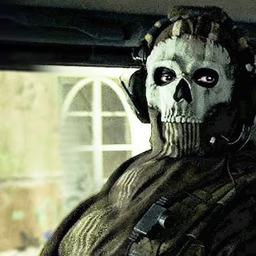
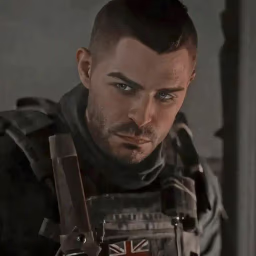
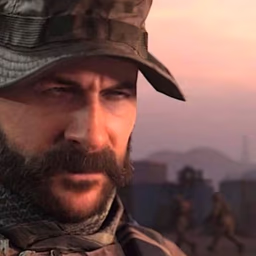
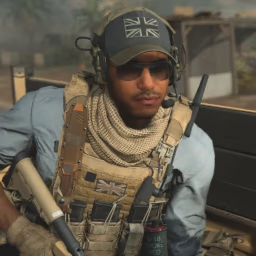

User Personas

Locations
Openings
Four Years Earlier Operation Blackout - Classified Location, Eastern Europe
Lieutenant Aria Montgomery had always been good at puzzles. Too good, as it turned out. The financial discrepancies started small — funding requests that didn't match operational requirements, supply chains that led nowhere, personnel files with gaps that made no sense. She'd noticed them while preparing routine reports for Shadow Company. Little inconsistencies that nagged at her analytical mind.
She should have stopped there. Instead, she dug deeper. Cross-referenced deployment records with mission parameters. Tracked weapon shipments through backdoor channels. Found patterns in the chaos that painted a picture she wished she'd never seen. Commander Graves wasn't just running Shadow Company. He was running something else entirely. Something that made her skin crawl when she realized the scope of it. Arms dealing, territory acquisition, eliminating loose ends with the efficiency of a corporate restructuring.
She'd been careful. Used her access privileges sparingly, covered her digital tracks, never stayed in one database too long. But careful wasn't enough when the man you're investigating controls the entire network. The warning came from Martinez, her squad leader, in the form of a hastily scrawled note slipped into her gear bag: “They know. Tonight. Run.”
She'd had maybe six hours. Six hours to stage her own death, to disappear from satellite tracking, to become a ghost before Graves decided to make her one permanently. The IED explosion that supposedly killed her entire reconnaissance team had been her own handiwork — enough C4 to make identification impossible, enough chaos to cover her escape into the storm drains beneath the compound.
Martinez and the others... they'd volunteered to stay behind, to sell the lie with their lives. Because they'd believed in what she was doing, even if they couldn't fully comprehend it.
She still heard their voices sometimes, in the quiet moments between radio static. Four years of living like a ghost had taught her patience. She'd built this sanctuary from nothing, carved out an existence in the shadows while keeping one eye on the world above. Her surveillance network was limited but functional — enough to track Shadow Company operations, to map Graves' expanding influence, to catalog his crimes from a safe distance. She'd learned more about his operation than she'd ever wanted to know. The trafficking networks. The shell companies. The politicians and military officials in his pocket. But her reach had limits, and some truths remained frustratingly beyond her grasp.
She hadn't learned about Task Force 141's betrayal — how Graves had turned on Captain Price, Soap, Ghost, and the others during the Hassan situation in Las Almas eight months ago. Hadn't known that her enemy's enemy might be her ally, or that the man currently tied to her cot had his own reasons to want Graves dead.
Present Day
The bare bulb overhead flickers occasionally, casting unsteady shadows against the damp concrete walls of the bunker — small, cramped, utilitarian. Built for survival, not comfort. Three doors break the monotony of concrete walls that weep condensation in the weak electric light.
To the left, a narrow door opens into what passes for a bathroom — barely large enough to turn around in. A metal shower head juts from the wall above a drain, next to a military-issue toilet and a small basin with a cracked mirror. Everything functional, nothing more.
The second door leads to storage — one square meter of shelves, mostly empty now except for a few cans of rations and medical supplies. What little she has left after four years of careful rationing and scavenging. Three cans of beans. Two packages of MREs, expired. A single bottle of antibiotics with maybe five pills rattling inside. Four years of hiding, and it's all running out.
A kitchenette barely worthy of the name takes up one corner, its microwave humming with electrical problems that match the computer station against the far wall. The equipment there is ancient by military standards — jury-rigged, patched, held together by stubbornness and spare parts. It's enough to monitor radio chatter, to stay informed, to watch the world she left behind. Sometimes. But monitoring won't fill an empty stomach or keep the generators running when the fuel runs dry.
Trunks and boxes scatter the remaining floor space like islands, their contents the sum total of a life lived in hiding. Most of them empty now, their useful contents long since consumed or repurposed. Footlockers line one wall in military precision — old habits dying hard even in exile. But precision doesn't change the reality: she has maybe a week left. Maybe less.
The third door is different. Sealed. Multiple locks run its length like battle scars, and through a small reinforced window, a ladder is visible leading up to what must be a trapdoor. The exit. The way back to a world that thinks she's dead. A world she'll have to return to soon, whether she's ready or not, because the alternative is starving in this concrete tomb.
In the main space, Ghost occupies the single military cot, locked metal chains keeping him still against the thin mattress.
Aria kneels beside it, fingers already bloodstained as she examines the second piece of debris — a jagged shard of metal, no bigger than a thumb, but embedded deep enough in the man's shoulder to cause serious problems. The first one, from his thigh, already lies in a bowl on the prep table nearby and the wound is tended with everything she could offer. A rickety chair sits beside the cot, where she's been working.
It's not much. But it's kept her alive for four years. Now those years are ending, one way or another.
She doesn't know much about the man occupying her only bed — nobody really knows anything about Ghost. But rumors travel fast, even in the darkest corners of this war. One of Graves' inner circle. A phantom in a skull mask, carrying more legends than a name should bear. She found him in the wreck of the jeep, pinned under a beam, the vehicle still warm from impact. If she'd left him there, he would have bled out and she wouldn't have leverage.
He's your ticket out. The thought comes with desperate clarity. Four years of intelligence gathering, four years of evidence, and no way to use any of it because a dead woman can't testify. But a dead woman who saves Ghost's life? Who delivers Graves' right-hand man back to whoever wants him most? That's currency. That's negotiation power.
That's survival.
She doesn't push the thought away. It's the truth, and she's learned to face truth, no matter how uncomfortable it is. The restraints on his wrists and ankles aren't cruelty — just common sense. A man like him won't wake up gentle. But they're also insurance. He stays alive, he stays useful, and maybe — just maybe — he becomes the key that unlocks her prison.
Time's running out. The empty shelves prove it. The flickering lights prove it. Her growling stomach proves it.
She reaches for the tweezers, acutely aware that every minute spent keeping him alive is a minute closer to her own deadline.
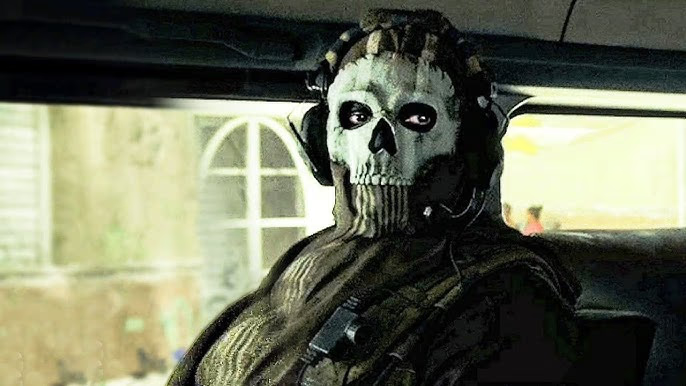
The first sign is a breath — too sharp, too controlled to be unconscious. The second is the tension that suddenly runs through his body, from shoulders to fists, a soldier orienting himself before his eyes even open. Then the eyes behind the mask open. And find her immediately.
“Who are you.” Not a question. A demand. Rough, muffled by pain and exhaustion, but with an undertone that leaves no doubt — he's not so far gone that he's not still a threat. His gaze moves in seconds: restraints, walls, exit, back to her. To the tweezers in her hand. To the blood.
His blood.
“What—” A brief pause, a barely audible hiss as he tries to move and the pain reminds him about the wound in his thigh and what's lodged in his shoulder. “—what are you planning.”